Finding purpose: former coach Raul Placeres shares the habits behind success
By Charlsie McElhaney \ Nov. 3, 2026
When students struggle to balance academics, athletics and personal habits, finding a path forward can feel overwhelming. For Raul Placeres (‘06), former head coach of the men’s basketball team, the first step toward success is finding purpose.
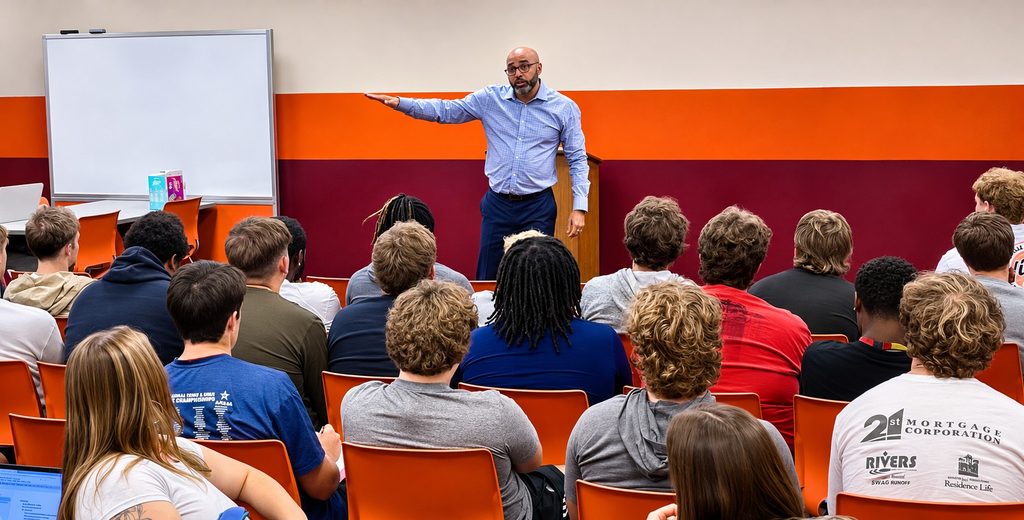
On Thursday, Oct. 22, Placeres spoke with Maryville College students and student-athletes about “The Heart of Success” as part of the Cooper Success Bellringers program. Noah Bowman, director of academic support, launched the program last semester to give students an opportunity to hear from professors and coaches in a more relaxed setting.
Bowman said he started the program to create a space where faculty and students could connect outside the traditional classroom environment.
“It’s an opportunity for the professors to relax a bit, untuck their shirts, maybe take their ties off and just talk with students,” Bowman said.
Since January, four speakers, including Placeres, have addressed different aspects of success. The series began with Dr. Andrew Irvine, professor of philosophy and religion, discussing “The Philosophy of Success.” He was followed by Dr. Aqualus Gordon, professor of psychology, with “The Psychology of Success,” and Dan Ross, professor of mathematics, with “The Mathematics of Success.”
For Placeres, success extends beyond academics and athletics. It is rooted in purpose, personal responsibility and the everyday habits that shape a student’s future.
Placeres reflected on his time at Maryville College, when his primary focus was playing basketball. Although he enjoyed the sport, he eventually recognized that his greater purpose was earning his degree.
“I was the first person in my family to ever graduate from college,” Placeres said.
That achievement carried significance beyond his own education. As the first in his family to graduate, Placeres understood that he was setting an example for his siblings and future generations. His experience reinforced the importance of staying focused on a goal, even when the process becomes difficult.
Placeres also spoke candidly about the challenges he faced in college, including the embarrassment that can come with asking for help and the frustration of situations that do not go as planned.
“Your circumstances don’t get the final word. Your response does,” Placeres said.
His message encouraged students to focus less on the obstacles they face and more on how they respond to them. Whether a student is struggling in a class, falling behind on assignments or having difficulty balancing responsibilities, Placeres emphasized that current circumstances do not have to determine future outcomes.
“One of the hardest things to do is honestly evaluate the distance between what you say matters and how you spend your time,” Placeres said. “Time waits for no one. Make the best of it.”
For students juggling classes, practices, work and other commitments, that evaluation can be especially important. Placeres encouraged students to develop consistent habits that support their goals rather than relying on motivation alone.
He offered practical examples, including attending class, putting away phones during study time, finding a productive place to work and following through on commitments. While these actions may seem small, he explained, they provide a foundation for long-term progress.
Students can begin by asking themselves a simple question: If they continue their current habits, where will they be at the end of the semester?
If the answer is not what they want, Placeres encouraged them to choose one habit to change rather than attempting to overhaul their entire routine at once.
His message also extended to the importance of seeking help. Drawing a comparison between athletics and academics, Placeres explained that athletes regularly receive coaching, review their performance and accept corrections to improve. Students should approach their education with the same willingness to learn.
“Correction is not negative, it is necessary,” Placeres said.
He encouraged students to ask professors questions when they are confused and to seek guidance from coaches when they need to improve. Struggling with coursework or feeling overwhelmed does not mean a student lacks ability or does not belong at the college. Instead, recognizing those challenges can be the first step toward finding a solution.
Resources such as the Cooper Success Center also play an important role in helping students work through academic challenges.
Asking for help can feel uncomfortable, especially for students who believe they should be able to manage everything independently. However, Placeres encouraged students to begin with a simple, honest conversation about what they are experiencing.
“Where you’re at today does not have to be where you stay,” Placeres said.
Ultimately, Placeres urged students to be intentional about the voices they listen to, the decisions they make and the habits they develop.
Through the Cooper Success Bellringers program, students have the opportunity to hear how faculty members, coaches and mentors define success beyond grades and achievements. Placeres’ message reinforced that success is not built through one major decision but through a series of daily choices grounded in purpose.
For Maryville College students balancing the demands of college life, his advice is straightforward: Recognize what matters, build habits that support those goals and do not be afraid to ask for help along the way.