Should AI-generated writing aids be considered plagiarism? Here’s what MC faculty, staff and students have to say
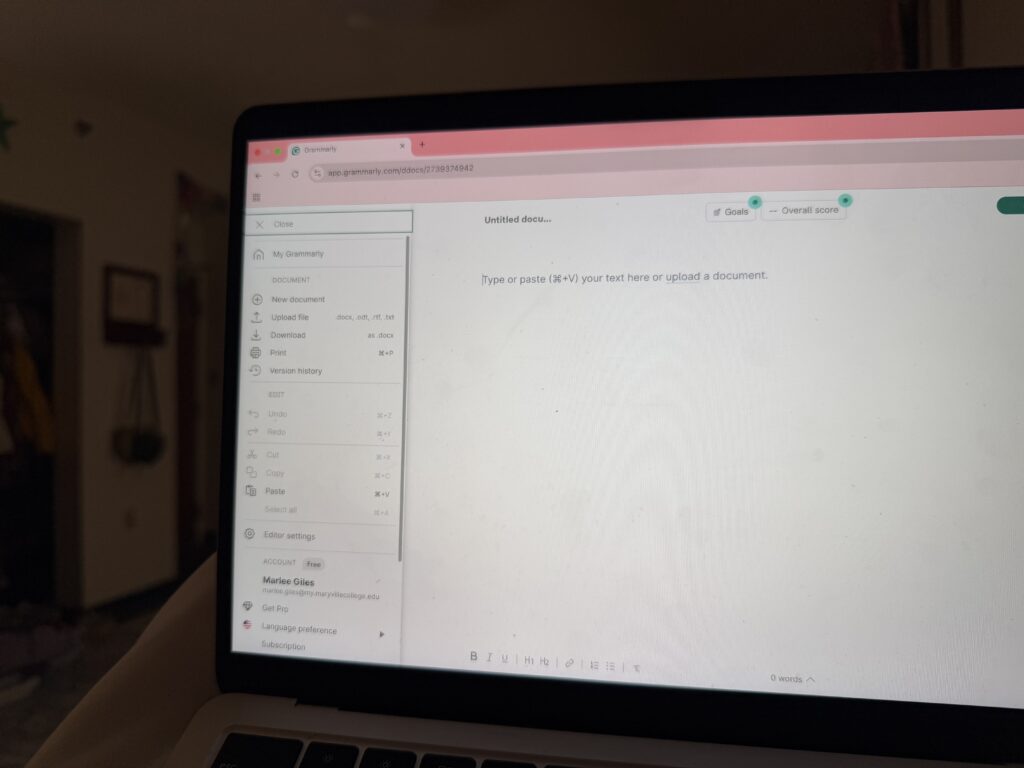
Over the past few years, the world has seen major developments in Artificial intelligence, commonly referred to as AI. Softwares like ChatGPT have been introduced and writing aids like Grammarly have adapted and become fully AI-generated. This has brought up a new conversation in higher education, with many wondering what falls under the umbrella of plagiarism.
Jan Taylor, a professor in MC’s division of languages and literature, has a lot to say. Taylor has done campus-wide research when it comes to AI in the classroom.
“I think that AI is powerful, exciting and fascinating, and I love it. But in an educational setting, I feel like it’s hazardous because education is about figuring stuff out, and if you are relying on AI to figure stuff out, you are opting yourself out of educational opportunities.” Taylor said.
Taylor states that AI writing itself can feel flat and repetitive, lacking the voice of an author. She said that she can tell a student she interacts with has used AI on a writing assignment when the voice in a paper does not match the voice of the student.
However, Taylor encourages her students to use AI on certain assignments, as she believes it is important to understand how to use the software and that it can be helpful with certain tasks. But, she will also give assignments that restrict AI usage, encouraging students to think for themselves.
“It’s only cheating if you don’t cite that you used [AI], and how you used it,” Taylor said.
Taylor also thinks that in most cases, using software like Grammarly is not too different from going to a tutor to get help.
“That’s how we learn, by asking for help. We need somebody to point out what we don’t know. Plagiarism and the whole issue around education has to do with [if you are] using the tool to learn and grow or using it to complete assignments and get points.” said Taylor.
Taylor did say that students using AI inappropriately or dishonestly has increased her responsibility to be suspicious. She further stated that suspicion is problematic in a learning relationship because she feels students learn best in a trusting and safe relationship.
Either way, Taylor has made it a goal to make AI usage less taboo and encourages more open conversations surrounding AI in the classroom.
Dr. Heather McMahon, MC’s assistant dean for academic success, shared many of the same thoughts. McMahon said that she has used Grammarly in the past, but has recently stopped using it because it is not the most secure of platforms. She encouraged students looking for similar software to take advantage of Microsoft Copilot or Google Gemini, secure resources that the college pays for for student use.
McMahon additionally stopped using Grammarly because she felt like it got to a place where it became invasive and intrusive, including more autofill than actual assistance.
She also stated that Maryville College is in the process of answering the very question of what counts as plagiarism when it comes to AI.
“There’s not an easy answer right now. It totally depends on the class, it depends on the assignment,” McMahon said. “But the truth is AI is here. It’s not going anywhere. So, to what degree are skills going to need development in different ways than they have before?”
McMahon also stated that her main fear is that students will lean into AI too much, leaving them without skills that are necessary to be competitive in the job market. She argues this would simply be students cheating themselves.
“That’s genuinely the truth of it, you can make it a certain way through life doing that, but eventually you are going to run against a roadblock where you are not prepared for what you are being asked to do because you don’t have the skills. So, why would you come to [Maryville College] and spend all this time and money and not develop any of the skills you need?” McMahon explained.
Megan Cooper (‘26), finds herself trying to answer these same questions, but on the other side of the table. Cooper does not use AI in a classroom setting, because she has developed a sort of fear of it.
“[One of my professors] accused me of using AI to write a paper analyzing the meaning of a poem. The school then put it on my record without consulting me or hearing my side at all.” Cooper stated.
Cooper also stated she had no idea what the AI policies were since she had never used it and never intended to use it, but she had Grammarly installed on her laptop and used it for revision. She says she was hoping to turn in a well-written paper, so she followed all of Grammarly’s grammar suggestions. Cooper knows Grammarly is the only thing that could have caused the assignment to be flagged for plagiarism.
“I received a failing grade on the assignment, and the professor wrote a letter that is now in my file with the college. Maryville College denied my advisor’s request that this accusation be disputed or that I submit my own letter for [my] file.”
However, Cooper does think that AI has a place within the academic community.
“I think AI can be used in academic settings. As an academic mentor, I see students using AI to help develop ideas or check for grammar mistakes. When used within reason, AI is a tool that I see being used as often as a calculator,” she said.
Additionally, Cooper has become passionate about defending writers and other creatives from AI and plagiarism accusations.
“I have decided since this discipline was put upon me, that my new life mission is to go to law school and spend my life defending creatives from AI. No student should go through what I went through, and no AI developer should be able to infringe on the copywriting of creative works.”
Dr. Will Phillips, interim division chair for the MC languages and literature division and an English professor for the college, said that he has used grammar checkers of many sorts over the years as they have evolved, but he tends to be annoyed with them as he is particular about the way he phrases things.
“For people who are less confident in their ability to put sentences together, it can be a big help. And I think in some ways that is the framework for AI.” Phillips stated.
“We don’t think spell checkers are a sign of academic dishonesty and haven’t for quite a long time. But on the other hand, most of us would hesitate to defend a student who entirely produced something through Chat GPT and passed it off as their own.” Phillips shared when asked specifically about the differences between writing aids like Grammarly and the use of AI “chatbots.”
Phillips also stated that AI policies should likely be class and assignment-specific, dependent on the end goal of the assignment. He, like many, emphasized that AI use can diminish your experience and the enhancing of your skills.
“If you use ChatGPT as a crutch and you couldn’t replicate something yourself, that’s probably where you aren’t helping your own development.” Phillips elaborated.
He also shared that while in some situations such as studying or outline preparation, the use of AI, while not cheating may not be wise.
So, the general consensus is that no one really knows where AI is headed or where it belongs in the classroom. Opinions on all fronts, even those of sites like Grammarly, clearly vary. Students should be cautious, prioritizing academic honesty and open communication with professors when it comes to AI.