Brian Childs (’69): stories from his time as Echo editor
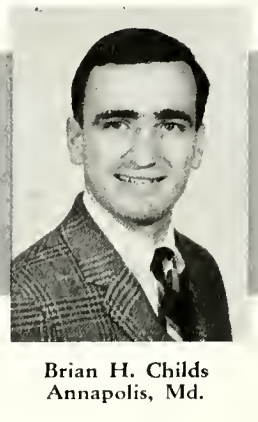
Brian Childs (‘69) attended Maryville College during a period of tremendous social change at a global, national and local scale. His experience at the College vastly differed from the perspective of modern students, and he helped shape some of the lasting changes through his leadership positions on campus.
Photo of Brian Childs (‘69) as a senior, taken from the 1969 edition of the Chilhowean
Courtesy of The Chilhowean Archives
“It was the late 60s, [so] there were a lot of changes everywhere,” said Archivist Amy Lundell (‘06). Lundell explained the curriculum changes that took place while Childs was a student, including the removal of chapel requirements and the transition from six days of classes each week to five.
I, Maddux Morse (‘27), current editor-in-chief for The Highland Echo, sat with Childs in the bustling Vienna Coffee shop in downtown Maryville, chatting about our different experiences in this role, which he held for two years. This was a rare occurrence, usually the editor was required to be a senior, but an opportunity arose when the editor quit, and Childs stepped up, taking the role as a junior.
Anecdotally, Childs told me stories of his time as a student, many of which took me by surprise. Childs told me that he took a mandatory physical education class, in which students had to prove their proficiency at treading water – which was a graduation requirement at the time.
“You had to be able to pass the swimming exam until the 1990s – you could not graduate until you passed that exam,” Lundell said, explaining that students with physical reasons why they couldn’t pass were exempt. “There are known students who passed everything but that exam… and they were retroactively given their diplomas.”
Childs shared some more striking memories with me. As the editor in 1968 and 1969, he was a firsthand witness to radical changes in the Maryville College curriculum and the social atmosphere of the city.
POLITICAL EVENTS
He recalled a story, describing it as the most shocking thing he had ever seen.
“Within a couple weeks of [the start of] my freshmen year, there was a Ku Klux Klan rally at the [Blount County] courthouse,” Childs said. “People showed up wearing gowns and hoods, [and they] burnt a cross.”
“The wife of one of our professors was an elderly woman, she gave candy to the KKK members saying: ‘If you look like it’s Halloween I’ll treat you like it’s Halloween!’… I thought that was really brave.”
This firsthand account of KKK rallies, which were sanctioned by the city of Maryville but opposed by the College and many of its students, was shocking to hear, so I dug deeper into the archival evidence with Lundell, who told me that students of color were not always welcome into businesses on “Town Nights”.
“Some students were in town on a Saturday night, and were threatened and almost barred from returning to campus,” Lundell said. “One white female student described the Klan members ‘roughing up’ [other MC students].”
In a letter written home by Rob Snow (‘72) in April of 1968, he detailed some of these treats.
“By and large the students ignored them [the Klan], but the leader of the group told [my friend] to spread the word that any Maryville Student in town tomorrow night would regret being there.”
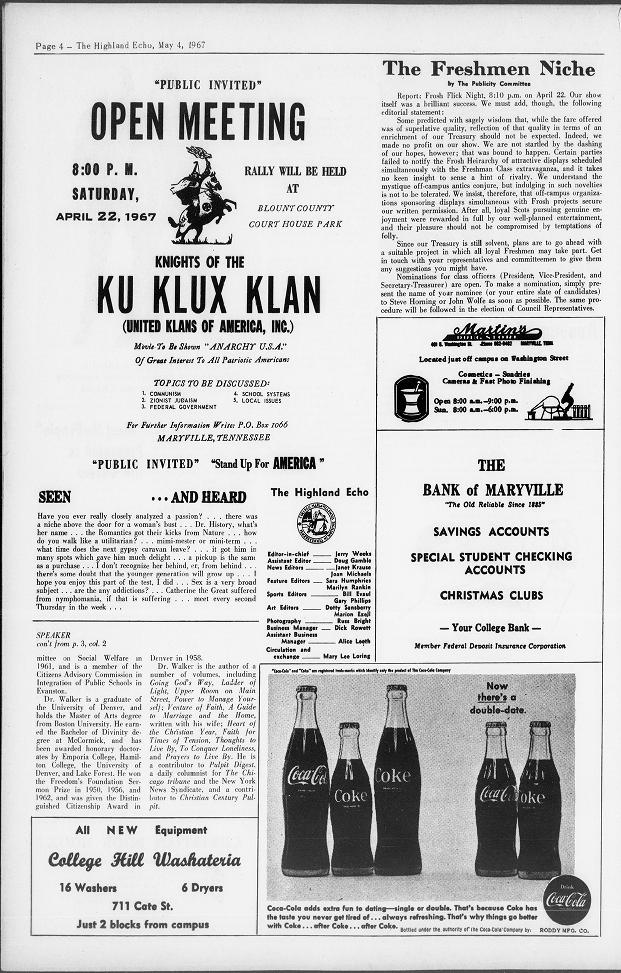
The Echo even published a flyer for one such KKK rally, essentially informing students of where not to go on Saturday, April 22, 1967.
Other significant historical events occurred while Childs was a student at MC, including the assassinations of both Martin Luther King Jr. and Robert Kennedy in 1968.
“The vast majority [of students] were in favor of what MLK was doing so when he was assassinated the campus went into deep, concerning grief,” said Childs. “And not much later, Bobby Kennedy was assassinated.
“There was the war in Vietnam, and there was the Civil Rights movement – those [events] radicalized the campus. There were a lot of folks who went to Maryville who were not happy with the civil rights movement and people who thought the Vietnam War was a just war. [There was] a lot of tension, and The Highland Echo always represented the more liberal student body,” he added.
Additional instances of violence in America greatly impacted the student body during this time, including the Kent State shootings, which was the killing of four students at a protest by the Ohio National Guard in 1970.
Lundell said that the College “held a special prayer service in memory of the four students. They called off classes and devoted the weekend to a discussion on serious and international events.”
While it was after Childs’ time at MC, the Echo followed the trials in the following months, including various student responses to the event. Childs recalled being in seminary school when the shooting occurred – it was a shock wave felt around the country.
CHANGES IN CAMPUS LIFE AND CURRICULUM
Campus life has changed greatly since the 60s. Childs recalled more stories of what it was like to go to Maryville College over 50 years ago, mentioning the historic bell atop Anderson Hall – which current students now only know from its location at the base of the Hall.
“They rang the bell at the top of Anderson Hall to tell you to go to chapel. The faculty would be there at the end of the row and take roll.” He added that if students missed a certain number of chapel hours, they would be docked academically.
“Every student was there, then you’d go off and eat breakfast. It was family style so you’d sit at a big table and they would bring plates of food,” he said. “Margaret Ware was the cook, now the dining room is her namesake.”
I found these stories interesting and endearing. Childs told me that students drank fresh milk from the farm. He said that when the onion grass came up in the spring, the milk would taste faintly of onion.
1968 was a year of lowered restrictions on MC student life. Lundell explained some of the changes, saying that students could have cars on campus, which was previously only allowed for commuters. Having a car on campus was still restricted to seniors, and required a benchmark GPA.
This change, coupled with the reduction in course schedule to only five days a week, had large impacts on student life.
“With a full weekend and vehicles, people could go somewhere,” Lundell said.
“Most of the curriculum and regulation changes were widely accepted and appreciated by the students,” said Lundell. “There was some hesitation with the All College Council because it was new.”
The All College Council, which Childs served on in its inaugural year, was a plan to help increase student communication with administration and utilize student perspectives to help govern the College.
While Childs served as a member of the All College Council, track team, editor of the Echo and Resident Assistant, his academic pursuits included history and philosophy, the latter of which he got his Bachelor’s degree in.
CAREER AND LIFE POST-COLLEGE
Childs credited the College’s multidisciplinary approach with preparing him for a career, nurturing in him a curiosity about the world and exposing him to new perspectives and critical thinking.
“I remember when I showed up at Princeton Seminary and they asked where I went to Undergrad… [When I told them MC, they] said: ‘you’ll do well here,’” Childs said.
“So, I went off to Princeton and did really well, and there’s no question it’s because of the discipline I got as a history and then philosophy major,” he said. “I took Latin four years, Greek two years [and] German two years. I took a semester of Middle English too. Dr. [Elizabeth] Jackson was the chair of the English department and she was probably one of the most gifted members on our faculty. She was brilliant.”
Since MC, Childs’ career path has been unique. He taught at Princeton, and then moved to Atlanta and taught at Columbia Theological Seminary. He then explained what he described as “an unbelievable experience” that “changed everything.”
“I got a national endowment for the humanities – they had a program with 10 physicians and 10 non-physicians, the people switched roles,” he said, meaning that Childs went to medical school for three years. “I then taught at Emory School of Medicine, worked in the University of Maryland Healthcare System and taught there. Then we left Maryland in 2014 and moved to Savannah Ga., where I teach.”
“By that time I had published two or three books and edited some journals,” he said.
Currently, he still edits and publishes in his area of expertise: the philosophy and history of medicine and medical ethics. This career has taken Childs up and down the East coast, but he is now settled in Savannah, Ga. and maintains his work as a professor and chair of the Department of Bioethics and Medical Humanities at Mercer University School of Medicine.
His wife, Ashley Childs, added: “He’s been in it for a long time, way before it was popular. He is one of the better known ethicists around the area and lectures across the country.”
THE HIGHLAND ECHO
In the 60s, the Echo was a cut and paste project for each issue. Today, many students have personal laptops, articles can be shared and edited with ease and we utilize InDesign software to create a layout.
While there are similarities – I, too, have spent hours working on the paper before publication – the process in the 60s was vastly different.
“We would type our stories on this special paper that the printer would then photograph and print. I would [sometimes be up] until two or three in the morning.”
During his time, Childs said that the Echo ran two publications a month, and their faculty advisor was a chemistry professor, Dr. Paul Ogren.
“We had a bunch of people who would write,” he said, adding that they had a “hard core staff of about five.”
Just like today, anybody could volunteer to write for the Echo or submit poetry or artwork.
“We focused a lot on the arts, we would have a lot of poetry and some really gifted artists would let us print some of their artwork,” as well as multiple cartoonists, he said. The cartoonists were John Ribble (‘70) and a certain S. Smith, who Childs said contributed some bizarre cartoons.
Another feature of the time was a “letters to the editor” section that ran in every issue, offering a chance for students, faculty or staff to respond to what was said in the last issue.
“They had a policy that there could not be an anonymous letter [to the editor],” Lundell said. “You could request that your name not be mentioned in publication, but they needed a paper trail.”
Journalism, like much else, has changed since the 60s. When I asked Childs if he had any advice to share as I enter my second year as editor of the Echo, he mentioned his concerns about modern journalism.
“I think it’s probably not possible to do it, but what concerns me the most these days is that there’s so much polarization that there’s no conversation,” he said, worry painted on his face. “It’s too easy to call your opposition crazy or fascists.”
He said that at age 79, he can appreciate the foundations behind what he would consider conservative positions. He thinks it is important to be able to debate and converse without ad hominems.
“Right now, we are attacking personalities and not opinions. That should be avoided and [we should] encourage more critical conversations.”
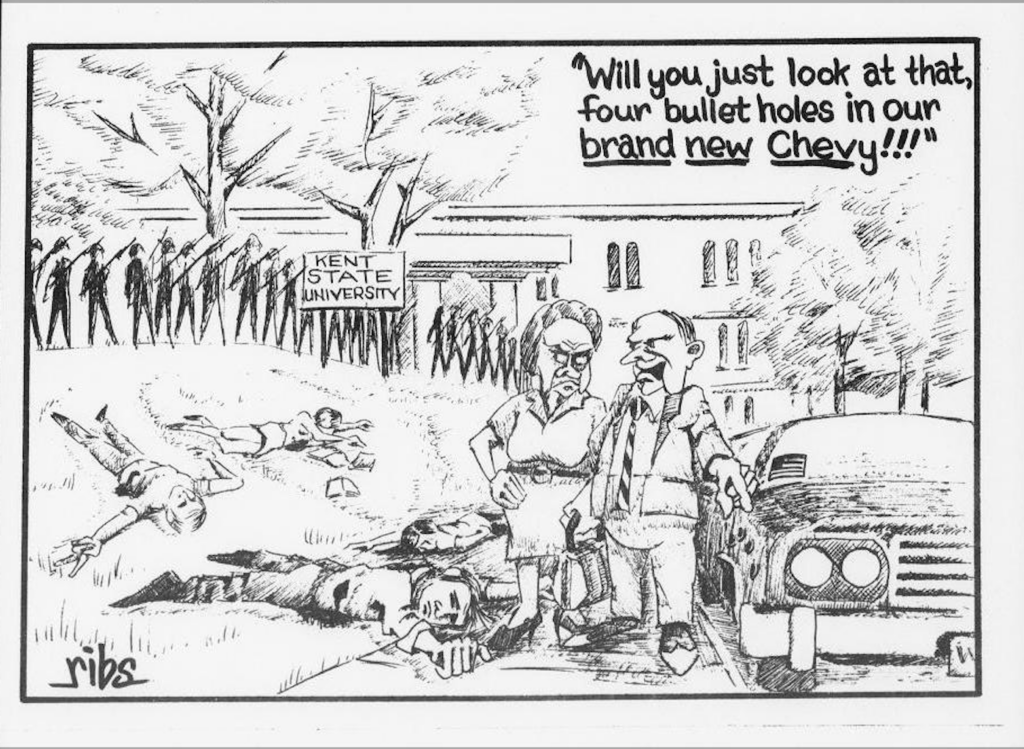
Political cartoon drawn by John Ribble (‘70) after the Kent State shootings in May, 1970
Courtesy of The Highland Echo Archives
Awesome article and subject!
Great article! It brought back memories of my days at MC and the many changes that occurred during our years there. I just finished transcribing a 1926 address by Dr. Samuel Tynsdale Wilson describing the reasons MC excelled in creating a Christian atmosphere. He mentioned mandatory morning chapel, Sunday night vespers, and February Meetings, all of which we still had in the 60’s. Brian mentioned the KKK meetings. They burned a cross on campus twice as I remember during our years, once for Julian Bond and another when the black minister who was head of General Assembly came to speak. Those of us who were Yankees were both frightened and appalled!