Protests on campus: student perspectives and how to organize at MC
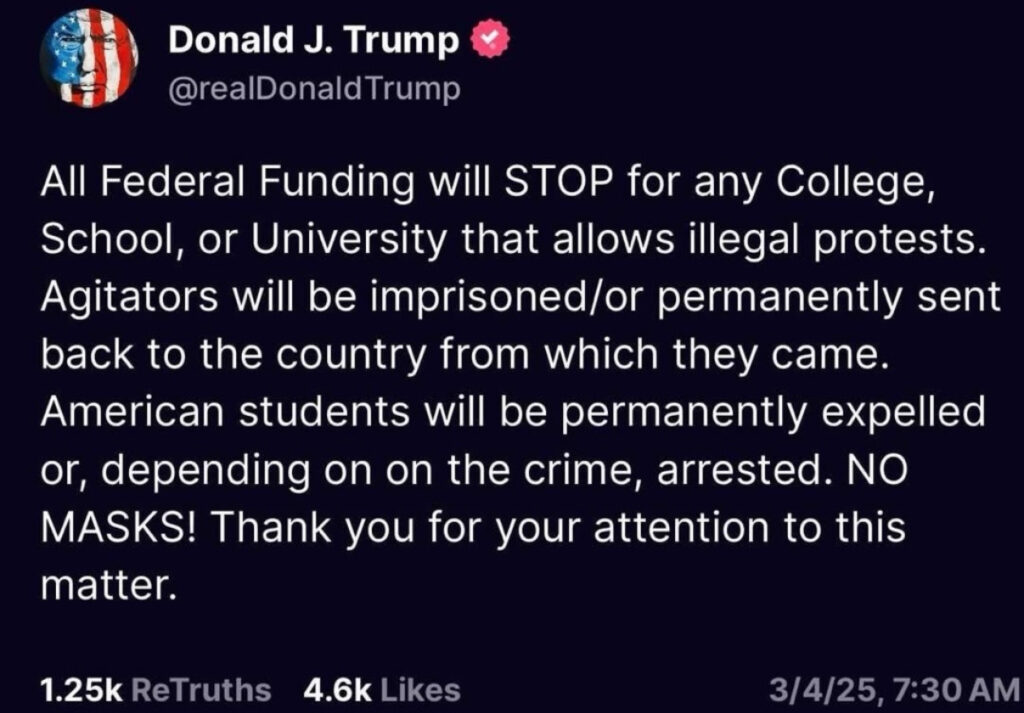
On March 4 2025, President Donald Trump made a post to the social media platform TruthSocial that reads:
“All Federal Funding will STOP for any College, School, or University that allows illegal protests. Agitators will be imprisoned/or permanently sent back to the country from which they came. American students will be permanently expelled or, depending on the crime, arrested. NO MASKS! Thank you for your attention to this matter.”
As a result of this post, college students everywhere were left wondering what that could mean for their campus. Many students at Maryville College recognize the importance of organizing, especially on a campus with a history of making a difference.
Stephen Cope (‘26) said, “Does “do good on the largest possible scale” mean anything if we cower and stay silent?”
At Maryville, students are familiar with this quote from Isaac Anderson, MC’s founder. This can relate to fighting for issues to bring good.
A current student (‘26) at Maryville College, who wishes to remain anonymous, shared their opinions on protests on campus in a broader sense:
“I feel that it is our constitutional right to hold protests, and colleges are a space where we are meant to learn and become informed. It seems like common sense to me that protests would happen on college campuses as that is the kind of atmosphere it encourages,” they said.
They suggest that college campuses generally foster an atmosphere that encourages students to make a difference; other students have applied this idea specifically to MC.
Meredith Howell (‘25) shared how she believes MC creates an environment that encourages students to be free, open-thinkers. She also tied back to our founder Isaac Anderson.
“Protests, such as pro-Palestine and pro-choice support, on our campus, I believe, would make Isaac Anderson proud,” said Howell.
Another student, who also wishes to remain anonymous (‘28), offered another, more cautious perspective.
They said, “please protest, but not on campus. It’s not necessary. Not to mention, most large-scale protests require permits anyways, and lacking permits is what makes them illegal.”
Students who do believe in the right to protest on campus wonder how they are to go about organizing.
Ben Stubbs, the vice president and dean of students at Maryville College, said, “Maryville College values and promotes the right of free speech and views self-expression as an integral component of the Maryville College experience for all members of its community, provided that the speech/expression does not violate federal or state laws and/or college policies.”
Stubbs shared MC’s policies on protests, which apply to current Maryville College students, employees, and visitors to the campus and other College property. On-campus demonstrations must be scheduled in advance to “promote the health and safety of the MC community and maintain regular college operations.”
To do this, one must first request approval from Stubbs’ office. Organizers must provide a description of the event, group size, date, location, time and duration, name of sponsoring club(s) and/or organization(s), contact information and all marketing materials at least five business days before the demonstration.
The college will try its best to approve demonstrations even if not requested at least five days prior, especially if it is in response to an unexpected event.
Prohibited materials and conduct include: the use of torches or open flames, the use of chalk or other means of marking college grounds or facilities, the use of amplified sound devices, behaviors that violate the Student Code of Conduct and/or the Discrimination and Harassment Policy, tents or bedding, installations that are left unattended by demonstration organizers, items reasonably determined by a designated College official to be a safety hazard, and items or behaviors that otherwise violate this policy and other College policies.
Permissible campus demonstration locations include Humphrey’s Courtyard (outside Fayerweather Hall), Pearson’s Hall Plaza and Thaw Hall Plaza.
Demonstrations, unless otherwise approved, must be within the college’s operating hours (8 a.m.-5 p.m.).
Students at MC have the right to and are encouraged to use their voices. MC strives to create an environment for students to do all they can to be the makers of change.