Copeland sprinklers set off, residents frustrated and confused
By Lily Shelton | Oct. 20, 2026
On Oct. 5, around 11:00 p.m., Copeland residents rushed out of the building as fire alarms sounded throughout the halls. Despite the late hour, many assumed this was nothing more than a typical fire drill, leaving phones, wallets, and keys inside the building. However, as more residents started to gather outside, it was confirmed that this was a completely unplanned event.
Unfortunately, one of the fire sprinklers was broken on the fourth floor. Numerous fire trucks and police officers rushed onto campus soon after residents left the building, but students were left in the dark until they were let back into the building in the early morning, while the Residence Life team, Maryville Fire Department and the Facilities team all tried to work together to figure out what the next steps would be.
At first, residents were encouraged to find another place to stay for the night and, following that advice, some left campus. Residents who couldn’t leave campus were told that they would likely be put in temporary housing for an extended amount of time, depending on the extent of damage that resulted from the water that flooded many of the hallways. Additionally, residents started to worry that they might not have access to their rooms for a few days; however, the night concluded with residents being allowed back into the building around 1:00 a.m..
Many residents have expressed frustration with the whole situation given that communication felt, at times, nonexistent, and residents were expected to proceed with classes on a regular schedule the following morning.
“When I heard the fire alarm, I figured somebody had either accidentally set it off or was pulling some bad prank. I would’ve never thought we would be out of the building for as long as we were,” said Copeland resident Hannah McCall (’29). “I wear contacts, but since it was bedtime, I didn’t have them in. I spent the whole ordeal not being able to see anybody or anything unless they were right in my face.”
“The girls on my floor and I fully believed the sprinklers in our rooms had gone off and soaked our things,” said McCall. “We were fully expecting to come back and find our things either soaked or destroyed.”
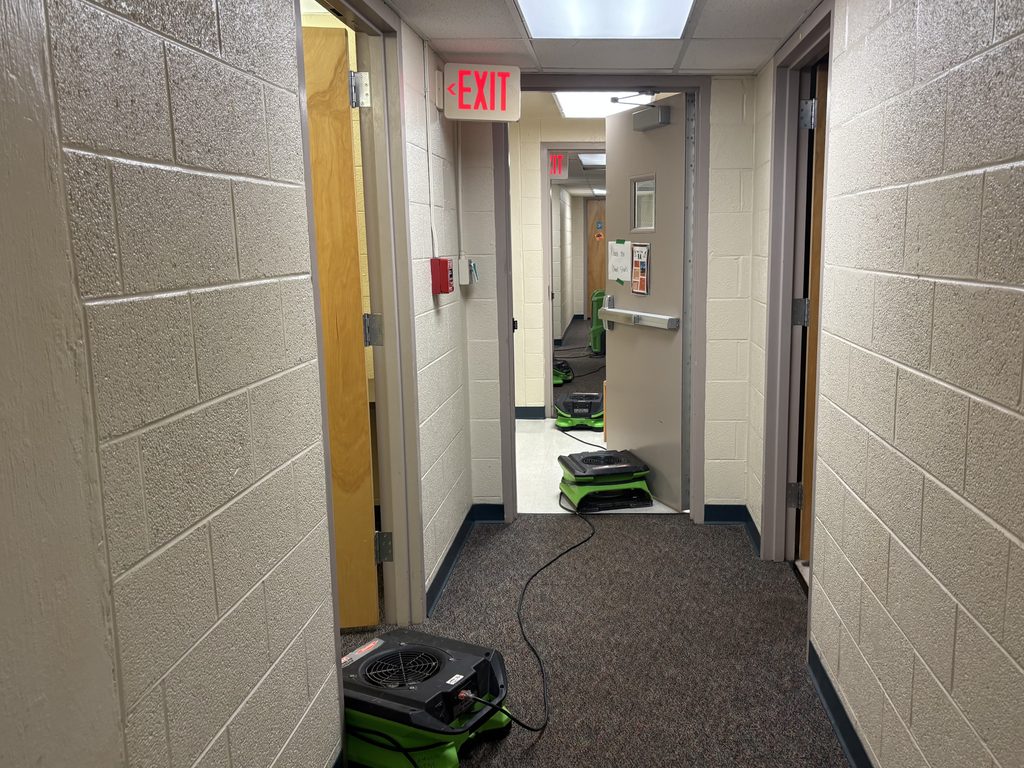
Luckily for Copeland residents, damage to the building was minimal, with much of the work to mitigate damages done by the facilities team and the Maryville Fire Department. While the city side of the building did experience moderate flooding from the sprinklers, damage was mostly isolated to common spaces and hallways, rather than resident rooms. However, some residents were still temporarily relocated due to the excess moisture on the higher floors, which had to be dried with loud, bulky fans throughout the halls and stairwells. These fans stayed in the residence hall for three days.
fourth floor in an attempt to dry everything out. Photo courtesy of Lily Shelton
In light of this incident, Associate Dean of Students and Director of Residence Life Daniel Roselli encourages students to purchase renter’s insurance to protect their personal belongings since the college does not cover any of those damages.
“We never expect accidents or unexpected situations to happen, but unfortunately, they can,” said Roselli. “Renter’s insurance can provide students with some additional protection and peace of mind, often at a relatively minimal cost.”
Most renter’s insurance costs about $15 a month on average, or about $180 a year or less than a dollar per day. In circumstances such as these, where many residents left phones, laptops, and more in their rooms, renter’s insurance could help save hundreds of dollars.
This incident helps bring to light the reason why tampering with fire equipment is something Maryville College takes very seriously. Scenarios like this can cost the school thousands of dollars, with costs going toward cleaning, repairing and paying for the hotel rooms of temporarily rehoused residents. Additionally, this night serves as an important reminder for students to always take alarms and alerts seriously — never assume it is just a drill unless previously communicated, and always keep your phone, keys, and wallet with you at all times when leaving the building.