Alexander Institute project as a major investment in Maryville’s scientific future
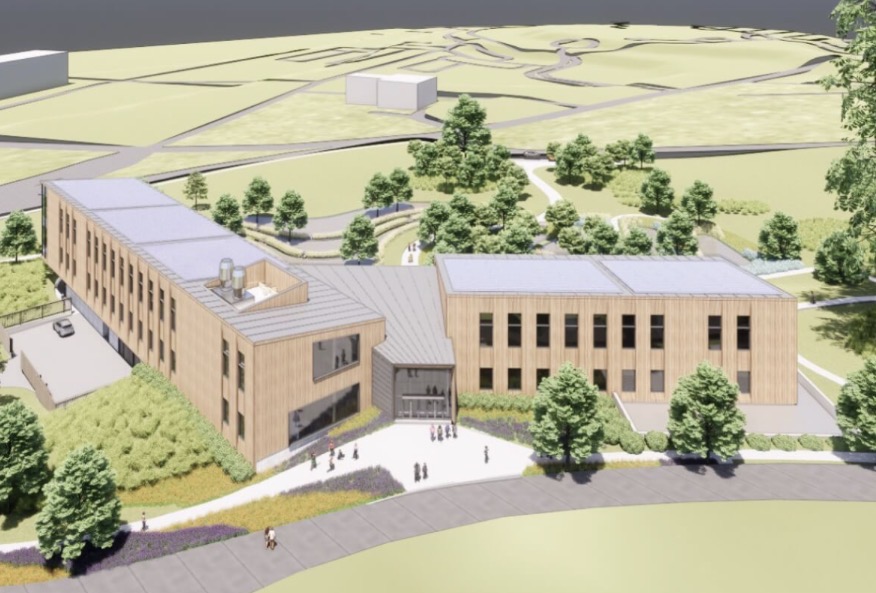
On Oct. 22, 2025, Maryville College announced the launch of the Alexander Institute for Conservation Leadership and the Sciences: a transformative initiative aimed at expanding the College’s impact in environmental education, scientific research and regional engagement. The proposed institute represents one of the most ambitious capital projects in the college’s history, blending academic innovation with public outreach. With construction planned to begin in late 2026, the College is seeking to raise $82 million to fund a state-of-the-art facility designed to serve both campus and community.
Following the announcement, questions quickly emerged, most notably about fundraising efforts and the long-term purpose of the institute. Shortly after plans were unveiled, the State of Tennessee committed $12 million to support the planning process. However, that contribution represents only a fraction of the total project cost, leaving $70 million still to be secured through private fundraising efforts.
When asked about fundraising, President Dr. Bryan Coker stated, “All the funding for the Alexander Institute for Conservation Leadership and the Sciences will be raised by the College, for the purpose of building the facility.”
Outside of the College’s president himself, the fundraising is led by Advancements staff and the Leadership Council of Fundraising volunteers. Some familiar names in the council are Dr. Bill Frist, honorary chair, Annie Haslam Colquitt, co-chair, David Colquitt, co-chair, and 49th Gov. of Tennessee Bill Haslam. A majority of the fundraising is planned to come from individual donors, foundations and some corporations.
As fundraising continues, faculty members have underscored the urgency of upgrading the college’s science facilities. Dr. Jay Clark, director of environmental & sustainability initiatives, spoke candidly about the current condition of Sutton Science Center.
“Sutton is… beyond tolerable, and that’s coming [from] a biology professor,” Clark said, stressing the need for updated labs and modernized learning spaces.
Still, questions remain about what could happen if the $82 million goal is not fully met before construction begins. Clark noted that while academic programming would remain intact, certain design features could be scaled back.
“Programmatically there’s nothing to cut,” he explained, before acknowledging potential compromises. “Given my position, I get concerned that the sustainability things will be the first to go because they tend to be more expensive.”
Both Coker and Clark discussed the importance of the Alexander Institute, not just for the college itself but also for the region as a whole.
“This will be a public facing, public oriented and public serving facility that connects our teaching and learning efforts with the public domain. The Institute is not just about the College’s future, but about the future of this amazing region we call home,” Coker said, clearly excited about the wide-reaching effects.
Outside of being a science center for Maryville College students, the Alexander Institute will offer two other centers for community involvement, the Haslam Center and Bill and Tracy Frist Center for Appalachian Wellness and Outdoors. The Haslam Center will provide a K-12 program.
Clark said “The Haslam Center is really the anchor of the building and the project regarding outreach beyond campus.”
The Frist Center will focus on environmental education now that Maryville College is a member of the Tennessee Environmental Education Association advisory group. While the Frist Center will focus on the intersection of health and the environment, the Alexander Institute will also provide many outdoor opportunities, recreation and tourism within the community.
As the late-2026 groundbreaking date approaches, the Alexander Institute stands as both an ambitious financial undertaking and a bold statement about Maryville College’s future. While significant fundraising challenges remain, College leadership and faculty alike frame the project as an investment not only in new facilities, but in long-term academic excellence, environmental responsibility and regional partnership. The Alexander Institute for Conservation Leadership and the Sciences could redefine the College’s role in conservation education for decades to come.
Aerial view of plan for the Alexander Institute for Conservation Leadership and the Sciences. Photo courtesy of Maryville College.