Maryville College students navigate political tensions on campus
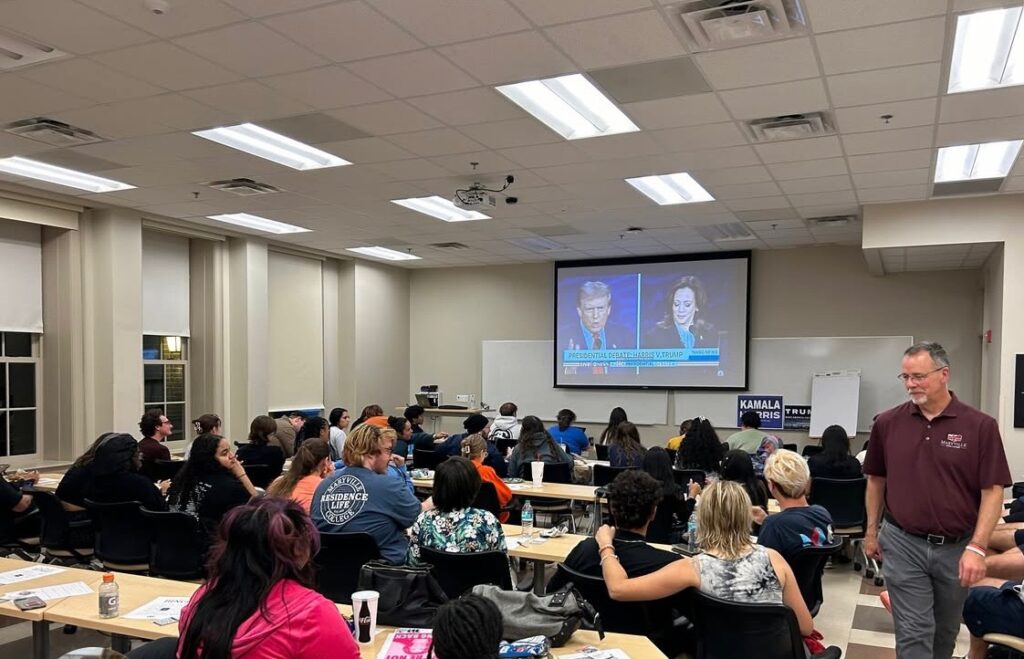
As discussions about equity, citizenship, freedom and liberty engross modern debates and political tensions rise across the nation, Maryville College students reflect on their feelings of safety and comfort within the campus community.
Through the lens of a private liberal arts education and a history of opposing overt oppressive tendencies enacted by the government, Maryville College is perceived as an institution that promotes political discussion and thought for the betterment of social attitudes.
While this perception of an unrestricted landscape that allows students to present all forms of dialogue safely is an ideal that Maryville College likes to display for students committing to the college, contesting opinions emerge in the current student body.
Reagan Holden (‘29) describes the political climate on campus as a “rocky slope…if someone treads carefully, they can make it down safely, if not, then they’re faced with hardships along the way.” Feeling she has to be careful when sharing political views on campus, Holden has felt a sense of weariness towards speaking up due to backlash.
Urging for an environment of open debate and discussion, Holden believes that Maryville College needs “more recognition of respect when it comes to differing political opinions.”
Michael Howard (‘28) echoes this sentiment, believing that, while the college provides generally healthy discussion in comparison to the rest of the country, there is still work to be done.
Although Howard believes that good diaogue has been spread around Maryville College, he believes there’s still improvement to me made towards positive conversations rather than unjust expression. “I also hear a lot of hatred and discriminatory language, especially towards religious minorities, and have heard from some students about some racial remarks made against them,” Howard added.
The political climate of Maryville College is seen as circumstantial by some members of the student body. As moments of major political debate are often fleeting, some students feel as if the conversations themselves, and the intentionality behind them, can come and go.
“I feel like most people are not comfortable enough to address the issues that are going on currently,” said Andre Darko (‘26). “The week of the Charlie Kirk killing, there were tons of people having open discussions on issues like gun violence in the U.S., but the following week everyone went silent again.”
While these moments can create dialogue, the issue of comfort in discussion, both in and outside the classroom, is a major concern for MC students.
“On one hand, I do feel comfortable sharing my opinions in class because it feels like a safe, open environment, but outside of the classroom, I feel a little bit more hesitant because as a minority, I’m just personally more cautious of these things,” Darko said.
While some find comfort in the classroom, others feel that the classroom setting can be confining for those with opinions deemed unique politically. Emma Clonan (‘27) finds the classroom setting to be more constricting, believing that the majority of the political views on campus are left-leaning, with professors and faculty reinforcing this.
“In social settings, I have always been treated with respect and offered an open mind when it comes to agreeing or disagreeing about politics,” Clonan said. “However, I don’t think I feel comfortable sharing my thoughts in academic settings as much, even as a political science minor, just because there aren’t as many open minds in the classroom.”
Rebecca Johnson (‘26) echoes this sentiment of discomfort at Maryville College, finding the political climate to be tense and polarizing. “I have shared my Christian conservative values openly at Maryville College several times, primarily via social media, and I have received intense backlash,” Johnson said.
“Students here have gone so far as to say I should be removed from my campus leadership positions and fired from my job on campus simply because I am pro-life and openly oppose abortion…students here have called me names, sent me awful private messages, and posted about me both anonymously and publicly,” she added.
Proposed solutions for making Maryville College a more inclusive and open space for students to express themselves freely differ across the student body, with some believing it to be a personal initiative students here need to employ, especially in regard to social media usage.
“I hope we can all someday agree to stop using Yik Yak as a political debate field,” Clonan said. “This is never productive, and it is pretty useless in my opinion, simply because identities are stripped. Anonymous political discussions, like any anonymous forum, enable people to be more hateful or judgmental.”
Johnson believes that a better accountability process can be initiated “for mistreating those with whom they disagree. I acknowledge, however, that accountability is not always possible when a lot of the hate occurs in anonymous ways, such as posts on Yik Yak.”
As some members of the student body believe individual responsibility should be instilled throughout campus, others think a focus on institutional accountability can better the student body in political discussions.
Valis Ethriel (‘27) proposes that a step forward in progress could potentially come from student-run clubs and organizations, such as the MC Politics and Philosophy Club, promoting student discussion of important issues. “They could easily act as the starting grounds for informed and critical political mindsets to arise,” Ethriel said.
“People need to engage now, on their own terms, or they will have a rude awakening when [they are forced to] later by people who don’t believe they have a right to exist,” he said.
Outside of student initiative, Ethriel thinks the institution itself could become much more proactive in its approach to making its stance on political issues more public, encouraging the student body not to avoid discussions, debates and actions.
We already have our mottos, so the college should put them to use, call out when our officials fail to ‘do good on the largest scale’ [or] actively fight against ‘integrity, scholarship, and respect’.”
“The students who are capable need to be inspired, and the ones who are afraid need to be taught,” Ethriel said. He added that some students may respond negatively to the college “making it clear that politics matter in our lives, and now is the time to be educated, prepared, and involved.”
For those students, Ethriel says they will either become better people through exposure, or that their close-mindedness would cause them to leave the college, “and that those individuals would only bring down our college from its proclaimed stance of scholarship, integrity, and respect anyway.”
Ethriel added that the college needs to make a clear statement that to support governing officials going against Maryville College’s values is to abandon their oath, and that the greatest act one can use their education for is to fight for those these policies directly affect.
Maryville College students watch a livestream of the Presidential debate between Donald Trump and Kamala Harris, November 2024. (Photo Courtesy of Maryville College.)