Now trending: MC Fashion Club’s shift to the sustainable
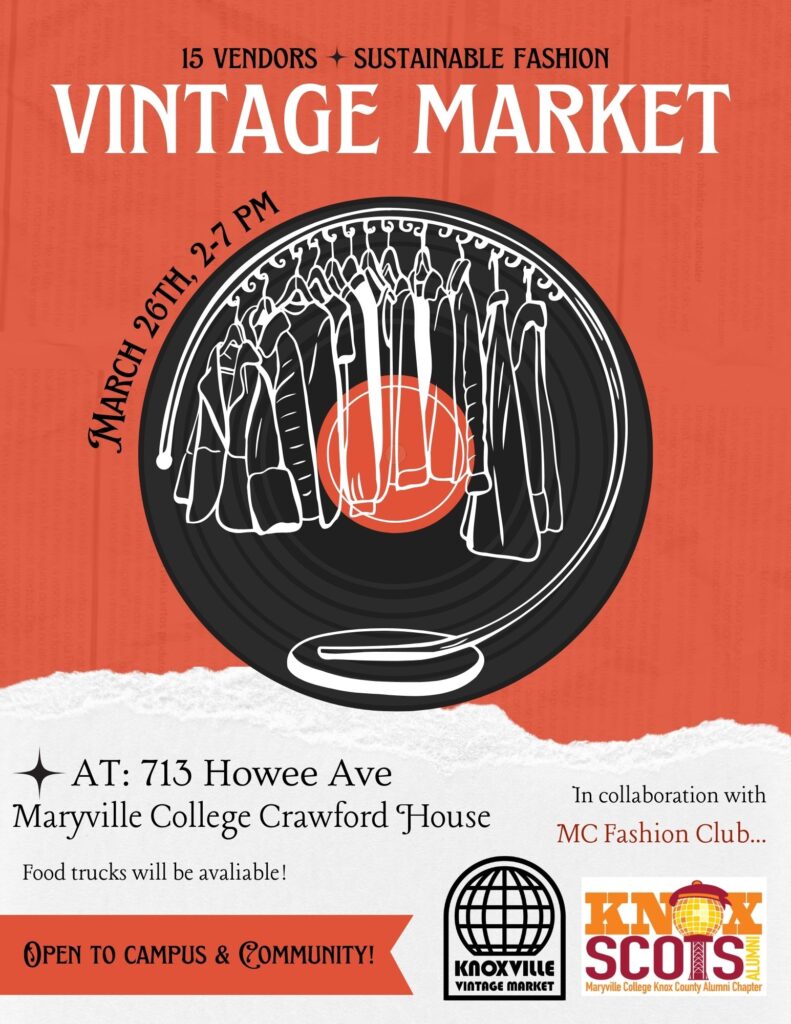
One vintage market has already made an appearance on campus earlier this school year, back in November 2024. This market was so popular with the campus and local community that a second vintage market will be happening this semester, giving students an opportunity to shop locally and sustainably. The MC Fashion Club will be hosting the market on March 26 at the Crawford House from 2-7 p.m., in collaboration with Maryville College’s Fit.Green.Happy. program. Fashion vendors and food trucks will be available.
Vintage markets like these are a way for shoppers to support sustainability in fashion. The word “sustainable” is thrown around often, with people looking to combat consumerism with thoughtful and eco-friendly purchases. Sustainable fashion is the making and distribution of clothes in ways that are healthy for the planet, as well as the employees who made the garment.
This means finding clothes that are not from abusive sweatshops, clothes that can be worn for a long time, clothes that can be donated, thrifted, or resold and clothes that are made from environmentally friendly materials.
“Sustainable fashion still promotes style and outfit coordination, while also bringing awareness to the huge waste of the fashion industry,” said Eden Carnes (‘27), the social media manager of MC Fashion Club.
“Every garment made from non-natural materials still exists in some form today. Every season, more and more pollution is sold to consumers under the guise of being the ‘hot new look,’” she said.
In the age of social media and influencers, trends circle through popular culture at an incredible pace. Every month, new trends emerge and old ones are cast aside. This has created an increase in consumption and waste in the fashion community. Last season’s clothes are discarded, piling up in landfills, while more clothes are produced, in typical “fast fashion” manner.
Thus, an important step in combating fast fashion, which uses mass-producing sweatshops and cheap materials, is to put more thought into where our clothes come from. Secondhand shopping is a great way to avoid supporting these fast fashion businesses and corporations, instead keeping money in the local community.
“I think one of the most important and lasting sustainability impacts you can make as an individual in today’s world if you want to “go green” is to think about how you spend your dollar,” said Jackie Eul, assistant director of Mountain Challenge and program director of Fit.Green.Happy.
“It is like casting a vote every single day. With the boom of vintage markets, thrift shops and just shopping second-hand in general, it is a great and attainable start, especially for college-aged people.”
The vintage market is not only a fantastic opportunity for buying unique pieces, but also for making connections. Eul mentioned that many of the vendors at this market are not just vintage collectors, but they have countless other positions in the community.
“These vendors love to talk about fashion, sustainability and the “makers” experience. Sometimes the vendors do markets full-time, but other times they have full-time jobs,” said Eul. “This market is a great networking opportunity for Maryville College students, especially if they are looking to move to the Knoxville area and pursue work.”
Bridging this connection between the community and the campus is an important part of both Fit.Green.Happy. and Mountain Challenge. Fit.Green.Happy. is the nonprofit arm of Mountain Challenge, an entity that has been working with the outside community for the last 35+ years, and they are the ones who have extended the invitation to Knox Vintage Markets to hold these events.
“Not everyone is going to come climb the tower at Camp4 and not everyone is going to be interested in shopping the market, but hopefully by offering both, we attract both groups,” said Eul.
But of course, as well as being an eco-friendly market, it is also a fashion market, and the Fashion Club is thrilled to help facilitate this event. One of the Fashion Club’s main goals is to help students express a positive self-image while remaining environmentally conscious, so events like these are a perfect intersection of both sides.
“The vintage market does something that a lot of sustainable fashion industries don’t do, it creates a unique sellable atmosphere,” said Carnes. “Even if you aren’t into second-hand or vintage clothes, who wouldn’t want to attend a funky eclectic market? Community is formed by rifling through racks of crazy print tops or bulky bedazzled sweaters.”