
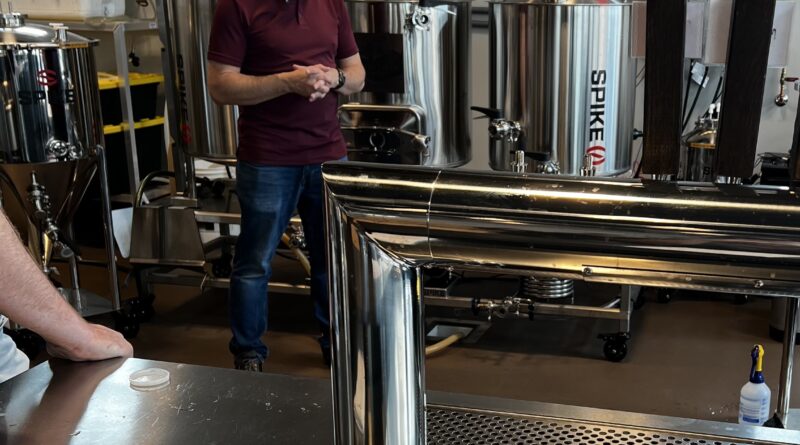
Fermentation Science students utilize new equipment for beer making at MC’s downtown center
MC’s fermentation classes have been popular among students since their conception, and with new equipment at Maryville College’s Downtown Center, the brewing is only getting better.
During the 2024 fall semester, Maryville College inaugurated the new Downtown Center, which, among other things, has become the house for the Fermentation Sciences at MC. The new lab at the Downtown Center allows students the opportunity to learn how to operate fermentation equipment, giving students a unique experience.
The brewing class was first introduced at MC in 2018. Back then, it was an elective, and students had to use more unconventional methods and equipment to go through their work.
Dr. Nathan Duncan, associate professor of chemistry and teacher of the brewery course explained what it was like to work with what they had back in 2018.
“It was a lot more clumsy because we didn’t really have a dedicated space and because, for example, when you’re boiling five gallons of warp for making beer, you have to do that outside and that meant if it rained, you know, we had issues with that, so it was a lot harder,” he said.
With the new facility and equipment, things can go a lot smoother and they can put all of their focus on their craft, making the fermentation minor run much better.
“[The lab] gives us a lot more flexibility to set things up and do things in a lot more of a controlled way,” said Duncan.
“They went from how most home brewers start out, with your igloo coolers and your big vats brewing out in the outdoor classroom, but now we have the super cool equipment. We’re the first class that has gotten to use this super high tech, high level equipment that they use in the industry, which is awesome” added Kaitlin Koster (‘25).
The new lab was designed to replicate the facilities of big corporate brewers in a smaller scale, giving students the opportunity to gain experience that will help them if they decide to pursue a career in the field.
“What I tell folks is that what we’ve built over there is the world’s smallest professional brewery,” said Duncan. “We have all the things that a very large, Budweiser style brewery would have in there, in terms of testing equipment, the fermenters that we use, the brewhouse that we use, they’re all the smallest version of what a production facility would use,” he added. “Really, it reflects a lot more how like a professional brewing environment would be. So it’s a lot more realistic hands-on preparation.”
The Fermentation Sciences minor is designed to work with any major, and even though there is chemistry involved, outside the box thinking and creativity are much more important than following instructions or measuring the right amount of ingredients, added Duncan, emphasizing that fermentation and brewing are as much of an art as they are a science.
“Brewing is something that can be done really by anyone,” he said. [Some of] my best brewers have always been my art majors [because] we need that outside the box creativity. I can get a chemistry student to go in there and they’ll meticulously know exactly how much stuff to add, but I sometimes need an art major that’s willing to be like, what if we just throw this in and change things up and that’s sometimes how you make the best discoveries.” he added.
“The class is something that’s just totally different than what you’d expect from a traditional college experience. And that’s really what we wanted it to be, so you can be creative with it. You need to be creative. We don’t want boring beers.”
Although brewing was the first course in the minor, fermentation science entails much more than that, Duncan added.
“Brewing is just one small part of fermentation, and there’s other things that go into fermentation beyond just the actual fermentation process, like land management, agriculture, even human sociology, the way that societies have have formed in different parts of the world have been shaped and influenced by those societies’ discovery, implementation and use of fermentation,” he explained.
According to Koster, there is a lot to gain from the course and the minor both in a professional and personal level, including practical experience and soft skills.
“I really didn’t think that I would end up enjoying brewing as much as I do, but it’s definitely something that I can see myself pursuing after college, but a lot of the things that we’re doing also apply to everyday life, like working with that machinery and the quality control and the chemistry involved in it is also super beneficial,” she said.
So cool, love it!