
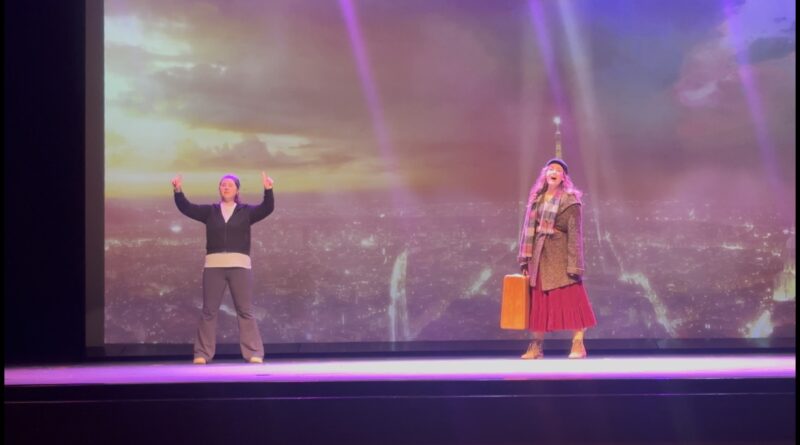
Three Maryville College ASL/English Interpreting seniors interpret Primary Players production of Anastasia
As part of the internship hour requirements for the American Sign Language/English Interpreting major, three Maryville College seniors volunteered to interpret the youth production of Anastasia by the Primary Players at the Clayton Center on Feb. 6.
Elizabeth Shwaiko (‘25), Emma Holmes (‘25) and Cheyenne Patterson (‘25) took on this responsibility—a commitment that started when they were given scripts in December.
“We got the script for the play before Christmas break and we all had to work like crazy up until the show,” Holmes said. “We had a lot of rehearsals together, but also spent a lot of our free time on individual songs and parts.”
This commitment included hours of practice outside of their joint rehearsals. One of the most important aspects of interpreting a production like this is expressing the intricacies of meaning that go beyond a word-for-word translation.
A lack of word-for-word translation from English to ASL is a common misconception about the language, explained Shwaiko. She also added that there is a completely different grammar structure.
“Preparing for a show is a long process,” Shwaiko said. “Interpreters have to go through the script and ‘gloss’ it, meaning: translate it from English to ASL, and then practice it until near memorization.”
“Glossing” is necessary because ASL is not the same language as English. The “gloss” of the script accounts for the facial expressions and body movements that the interpreter must learn.
Additionally, so much is conveyed in a performance like this through tone and inflection, which passes important emotional information to the audience. This is why interpreting is different from just offering subtitles, Holmes explained.
“You can’t just slap subtitles on something and expect every Deaf person to know what it says; English is most times a secondary language for Deaf people,” she said. “Subtitles and interpreters are two completely different things.”
“The way in which a line is delivered has an impact on the audience,” said Will White, director of the ASL/English Interpreting program at MC. “The interpreters need to hear how the actors deliver their lines so that they can best provide an equivalent in American Sign Language, and so that the Deaf audience has the same perception of the play as the hearing audience.”
In order to accomplish this, the interpreting team went to practices to listen to the actors and director. Doing this, they were able to maintain the integrity of the interpretation for their audience–including almost 50 Deaf kids, which White was thrilled about.
A relationship between MC and the Tennessee School for the Deaf meant that the show was advertised directly to a hearing impaired audience.
“We wanted to do our best for them and for any other Deaf audience members in the room,” Shwaiko said.
Holmes and Shwaiko both acknowledged that accessibility is not where it should be for hearing impaired viewers to enjoy live productions. They also both agreed that it was a great opportunity to be involved in making a show like this more accessible to the community.
Speaking on this issue, White also added his perspective.
“Unfortunately, a vast majority of live productions are not interpreted. It truly depends on the acting company or venue as to whether interpreting is provided or not,” he explained. “Unfortunately, cost often seems to outweigh the benefits of providing interpreters.”
An added level of intricacy with this performance was that Shwaiko and Holmes both provided “shadow interpreting”. This means that the interpreter shared the stage with the performers.
“This is somewhat more challenging than regular interpreting because the interpreter must be conscious of their place on the stage while keeping up with the complexities of the interpretation,” White said, adding that “the two interpreters that provided the shadow interpreting did an incredible job. They both incorporated certain movements or dress from the performing actors. This made the two seem like one person on stage.”
“When it came to the shadow interpreting part, it was a lot more difficult to sign while walking backwards than I expected!,” Holmes said.
While it was challenging to work in tandem with the actors, it was also challenging for the interpreters to work in tandem with each other.
“People have different signing styles and speeds, so having to watch and coordinate with each other was something we had to be conscious of,” Holmes said.
These challenges offered room for growth and experience to the interpreters, and these students were able to share their talents with a group of Deaf kids.
“The Deaf community’s commitment to helping our interpreting students to prepare for their future careers as sign language professionals is something we are eternally grateful for,” White said. “We are thankful they allowed us to interpret for them.
“I would also like to add that I am very proud of the students that volunteered for this project. They did a wonderful job. They exemplified the commitment to professionalism and excellence that are key elements of the interpreting profession. Even more importantly, they made it possible for the students and staff from the Tennessee School for the Deaf to access the true story of the play in American Sign Language.”
While not every interpreter can relate to the experience of a Deaf person, Holmes has a personal story that has led her to dive into the language and hope to find a career interpreting.
“When I was younger I had hearing problems myself, and my mom was always super worried I was going to go deaf,” she explained. “I relied heavily on lip reading to understand what people were saying. I guess it’s always been in the back of my mind that I would need to know how to communicate if I ever lost my hearing.”
“I want to change how the world views accessibility for disabled people of all kinds. Able bodied people should not force their way of living onto those that require accommodations.”