Changes in student affairs reshape campus experience at Maryville College
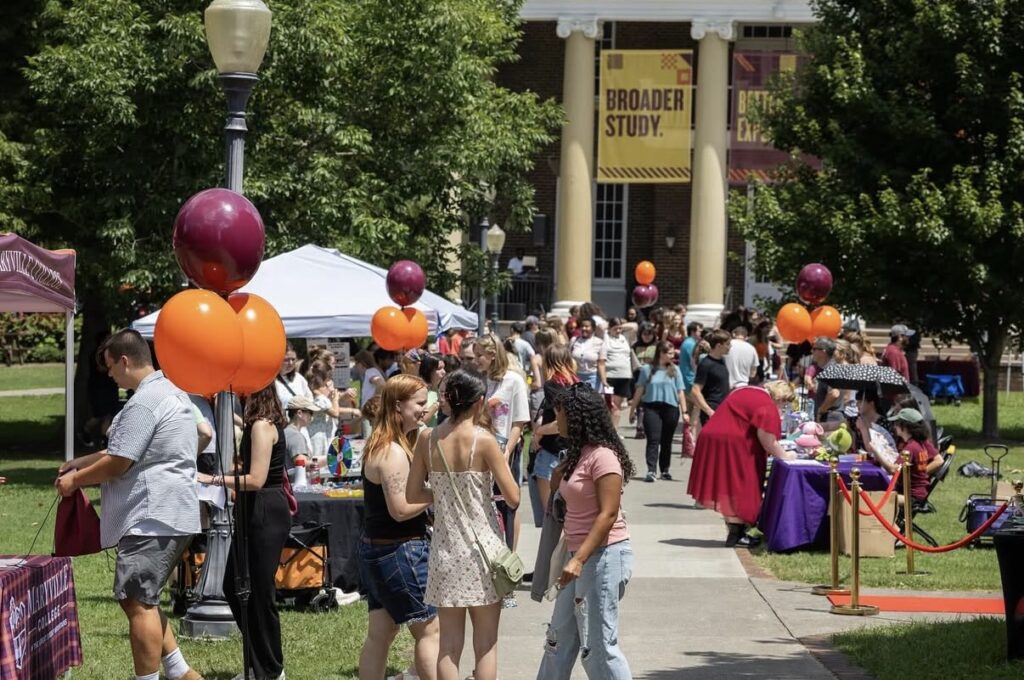
Maryville College implemented significant scheduling changes this academic year, relocating key events, such as Convocation and the club fair, to occur before classes began. The effects of these adjustments have rippled throughout campus life, with students reporting both benefits and challenges as they navigated a compressed, high-energy start to the semester.
The decision to hold Convocation before the first day of classes marked a notable departure from tradition, and students across different class years noticed the difference. Katie Parnell (‘27) observed that the change elevated the event’s significance.
“I think having Convocation before classes started made the event feel more special, and you could definitely feel that energy in the room,” Parnell said. She noted that “the entire sophomore and junior sections were pretty much full, and everyone felt very excited for the year to start, rather than being caught up in the busyness of the first day of classes.”
This contrasted sharply with her previous experiences, when few students attended her first year, and she skipped it entirely in her second year.
Stella Adams (‘27) offered a different perspective shaped by her experiences. While holding Convocation earlier didn’t significantly impact her transition this year, she recalled how beneficial Convocation was as a freshman last year, helping her understand what to expect and get into the right mindset. Now more experienced, she sees it as “a nice tradition, rather than something that impacts [her] transition.”
For students involved in the ceremony itself, the early timing proved particularly beneficial. Emma Mulligan (‘27), who participates in Convocation as a part of the Maryville College Choir, explained that having rehearsals and performances before the first day of class left her more time to focus and get ready for the beginning of the year.
All three students recognized how the restructured orientation created an easier transition, though they experienced it differently.
Adams explained how “this year’s start felt smoother and more intentional,” observing that “it seemed like everyone knew what to expect, and there was a better flow to the first week.”
Parnell similarly observed that this year’s beginning felt significantly more energetic than in past years, crediting the condensed move-in period and the strategic repositioning of events that traditionally occurred later in the semester to the orientation week.
The Student Involvement Fair, also held earlier than in previous years, generated substantial praise for boosting student engagement, especially for the clubs on campus. Parnell, the president of MC Pride Club, worked at the club’s table during this event, and she noticed a drastic difference in attendance.
“Pride Club had far more first-year attendees at our first meeting than in years past,” Parnell said. This increase reflected a broader trend of improved involvement across all campus organizations.
Additionally, Mulligan emphasized the scheduling benefits of the early timing, noting that meeting club representatives face-to-face before classes allowed her to intentionally plan her attendance at a club’s first meeting in advance. Even as a junior, she discovered clubs she hadn’t known about, making the fair valuable for returning students seeking new opportunities rather than learning about organizations at the last minute.
Beyond scheduling, students appreciated other organizational improvements. Adams particularly valued “how organized communication has been this semester,” and that “there’s been a clearer schedule and more updates about events and resources.”
Mulligan also found that “having some start times be later or more spread throughout the day was incredibly helpful.” This more relaxed pace helps to relieve the pressure of attending different events on campus. Mulligan compares this new, dispersed schedule to her first year orientation, which she described as feeling “very go, go, go.”
However, the compressed schedule hasn’t been without drawbacks. Mulligan also expressed concerns about the semester’s overall pace, surprised by how many major events—Convocation, fall break, and Homecoming—occurred earlier in the semester than in previous years.
She described feeling a persistent sense of urgency throughout the first half of the semester, with fall break immediately followed by Homecoming week, leaving little time for students to recover.
This rapid succession of activities proved particularly challenging for students actively involved in campus events, creating a snowball effect that left many wondering how the dynamic would shift once the initial rush subsided.
“I have a different experience being an RA, because I was on campus for several weeks beforehand,” Mulligan said. “But from interacting with peers, the schedule felt a little more rushed.”
As Maryville College continues to refine its approach to the beginning of the year orientation and the academic calendar, student feedback reveals a delicate balancing act between generating excitement and preventing burnout.
While the high-energy start has successfully boosted engagement and community building across class years, administrators may need to consider pacing adjustments throughout the semester to help students maintain momentum without feeling overwhelmed.
MC students gather outside of Pearson’s Hall to see what the student involvement fair has to offer. Photo courtesy of Maryville College.