Barron Hall’s impact on students, community and art
A strange deer-like creature sits on a bookshelf. It has two large antlers, a tail and mushrooms growing out of both of its sides. It has no facial features except for a wide open mouth, two teeth and a long, curved tongue sticking out. On the tongue sits the figure of a human whose head is squashed and red. Anyone who asks is told that the sculpture portrays the creature in Stephen Graham Jones’ “The Only Good Indians” and is advised to read the novel as soon as possible.
Inside a closet sits a wooden stool that has lived many lives. It is decorated with acrylic paint mixed with water, easily mistaken on first glance as watercolor. At one time, it was used to hang decorations from the ceiling. Too tall to be an end table, it served as a plant stand. Now, it’s a feeding stand for a cat with mats and bowls, and the cat’s outfits hang on the wall behind it.
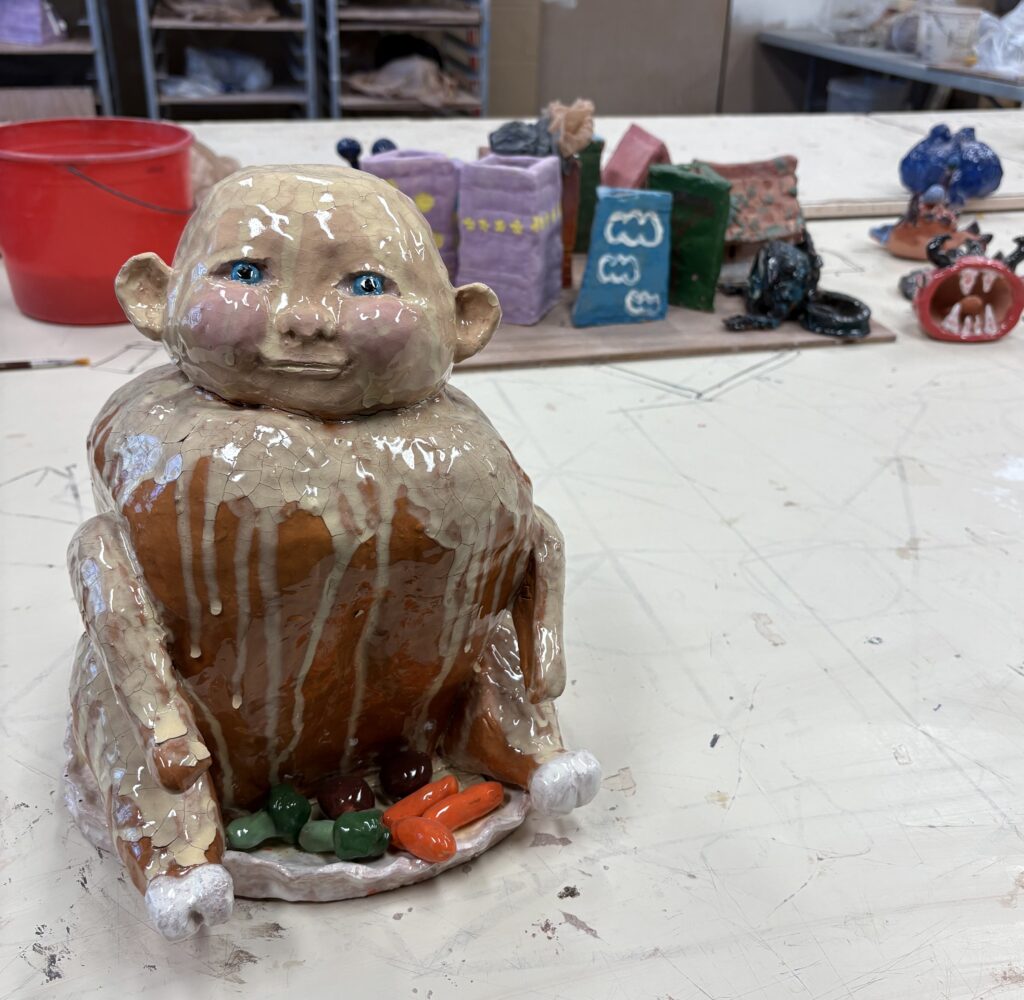
Inside a grandparent’s home sits a clay model of a building. The house is green and lofted off the ground. Two lanterns hang on either side. Once, it broke, and many hours of the night were spent fixing it despite having an exam early the next morning. It had to be fixed: it was a Christmas gift. The building is a replica of the grandparents’ summer home in New York, now sitting on display in the living room.
All of these projects were born in the same place, Clayton B016. Barron Hall, a visiting lecturer of art on the Maryville College campus, has allowed students to create pieces like this since he joined the faculty as an adjunct eight years ago. Since then, Hall has been teaching an assortment of art classes and, for the last two and a half years, has worked full-time at the college. Throughout his time here, Hall has guided, empowered and inspired his students.
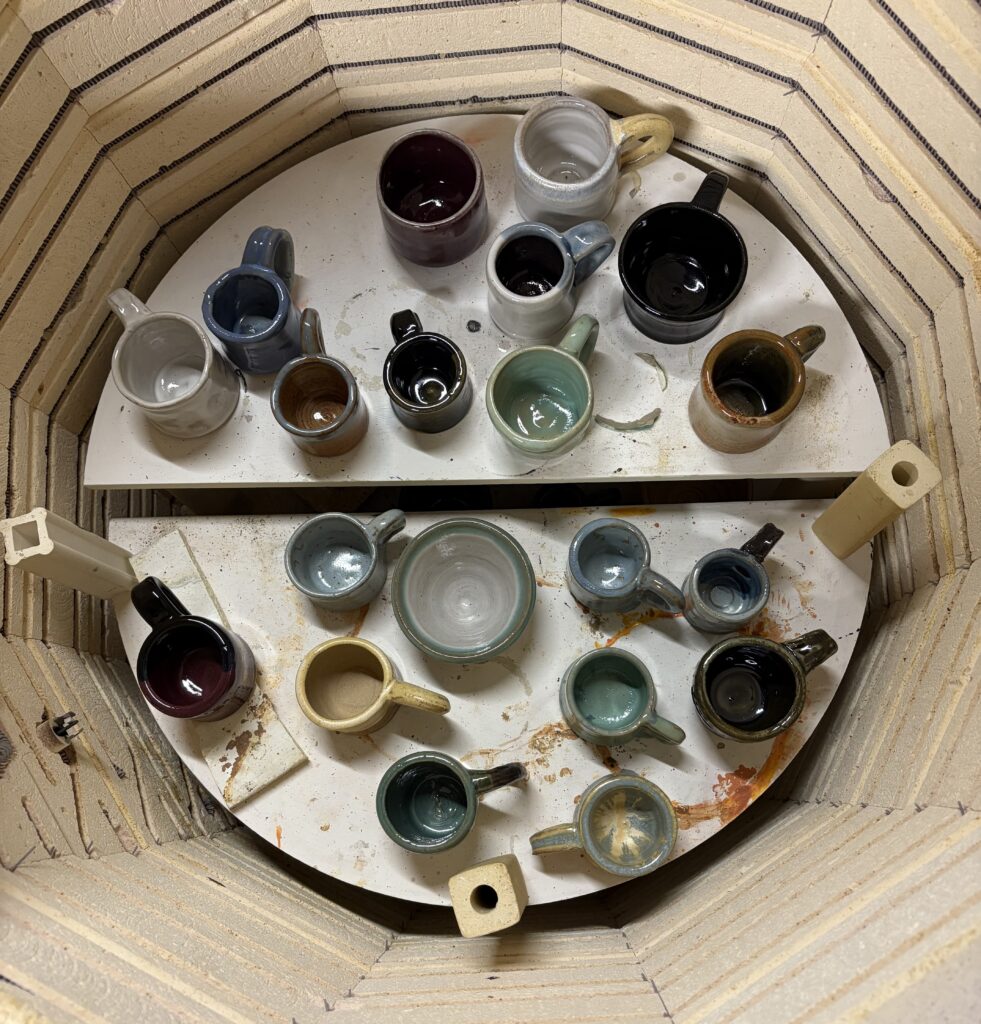
A kiln holds the finished pieces of Baron Hall’s Ceramics 2 class. Photo courtesy of Eva Blankenship
Student Impact
For each student who enters the studio, Hall has lofty goals for them to work toward in his classes. For those who aren’t pursuing art as a degree requirement, he hopes these students gain the self-confidence to trust that they can do things they didn’t know they could do. He hopes these students learn the indispensable skill of problem-solving. For art majors, Hall wants them to be able to enhance their skills and work to be able to produce what they can envision, as well as do the best work that they can.
“No matter what, I believe each student should leave my class with a new set of skills and a new way of looking at the world they interact with daily,” Hall said.
These student outcomes are not just hypothetical, but observable. When talking to both those in his classes and his former students, Hall’s lessons and insights hold strong in their minds. Aligned with Hall’s goals, several students remember his emphasis on developing their critical thinking and problem-solving abilities. Manderley Swain (‘26), a studio arts major with a focus in ceramics, is one of his students who has experienced this emphasis firsthand.
She described how Hall often interacts with students during workdays.
Swain said, “He will drift into the room several times while I’m [t]here and ask if I need anything. And then, he’s drifting out. But, if I have a question, he gives me all of his attention. Sometimes he answers it… [but] sometimes I think he just wants me to go figure it out. And I think that’s really effective. I think I learned more that way.”
The skills necessary to troubleshoot an issue aren’t the only lesson that Hall has imparted to his students. His classes also encourage a freedom to fail. September Wilson (‘24), who took his sculpture and 3-D design class while she was a student, remembers how Hall’s classes cultivated this mindset through the assigned projects. She recalls how many of the projects, such as one that involved using a saw to cut pieces of wood, could not be worked on outside of class because of safety concerns. Since there was a limited amount of time in class to work and a strict deadline, projects had to be finished without time to obsess over perfection. She recalls having to accept being done with an assignment and being unable to change it, even if something breaks or has flaws.
“It doesn’t have to be perfect because art in the real world is not perfect… and in all aspects of art, literally no matter what you do, you’re going to mess up,” Wilson said.
But the great thing about art and the classes that Hall offers is that these lessons are not confined only to the art classroom. Lessons in problem-solving and acceptance can extend into other areas of academics as well. Anna Price (‘26), an art major, has seen Hall’s lessons impact her even after leaving his sculpture and 3-D design class.
“Since taking classes with him, I still hold myself to a high standard but get less frustrated with my work when it doesn’t turn out the exact way that I wanted it to,” Price said.
Yet, even those not involved in the arts can benefit from the skills that Hall’s classroom provides.
“As a nursing major, I think taking his classes and having the experiences in two ceramics classes – which have really nothing to do with my future, my career – was a really great experience,” said Isabella Sprague (‘27). “And, I got some valuable lessons about perseverance, about making mistakes.”
However, lessons in determination, resilience and problem solving cannot be fostered in a restrictive environment. Luckily, students agree that Hall’s classroom is safe and welcoming. Price feels that, in Hall’s classes, she is always welcomed to be authentic. Wilson remembers going to his classroom as a break from all the “serious” parts of life. Similarly, Sprague remembers the classroom as a place where she went to work when she was having a bad day.
This safety is largely fostered by Hall himself. By showing up and being genuine, he creates an environment that encourages students to try, experiment and be authentic.
“His best trait as a professor is his patience and care in working with students and truly helping them to find their artistic voice, and showing his passion and excitement for them and their work,” said Adrienne Schwarte, associate professor of design and the chair of the College’s Division of Fine Arts.
His passion for students has made an impact on their lives.
“He was more of a role model and a confidant than he was an instructor,” says Wilson.
Swain added: “When I got here, I declared ceramics as my thing, and I’ve never felt less than in any way, even though I’ve been a ceramicist for like 10 minutes. He’s never made me feel like that.”
Ansley Sizemore (‘28), who took art history, as well as sculpture and 3-D design with Hall, put Barron’s impact simply: “He makes his classes ones that students want to go to.”
Jack of All Trades
Hall is much more than a lecturer. He is an artist, a member of the College and a contributor to his community.
Hall has always been an artist. Once, when he was in second grade, he won his school’s drawing competition, and he’s continued his focus on art since. He took art classes all throughout high school, and, despite taking some time away from school once he graduated, he eventually returned to college. He did well in his undergraduate classes, and he eventually went on to get his Master of Fine Arts degree. Beyond his expertise in the fine arts, Hall has owned a few different businesses, and he was a store manager for Starbucks for 10 years.
In Knoxville, Hall operates Mighty Mud, a ceramics shop and studio where he blends his love of art with his business expertise. Mighty Mud provides a multifaceted experience to customers. The store allows ceramic artists a place to buy supplies, such as tools and glazes, as well as a space for independent creation. The Mighty Mud studio also offers ceramic classes to the public led by talented instructors. Lastly, the gallery is a place that features artists’ works and allows them to sell finished pieces.
According to its website, Mighty Mud prides itself on being “locally owned and artist operated.”
Two years into owning Mighty Mud, Hall joined the faculty at Maryville College, where he has become an integral part of the campus community. He teaches the 3-D and ceramics concentration classes, along with general creative arts courses and art history classes. He has also served, on rotation with other art and design faculty, as gallery manager and director for both the Blackberry Farm and William “Ed” Harmon Galleries.
“He also assists students with gallery exhibition and competition submissions… helping them to be active artists in their community,” Schwarte said.
Hall puts so much emphasis on the Maryville community because he appreciates what the college allows him to foster in students. He appreciates the autonomy and control he has over his classes, including how and what to teach. Hall incorporates projects and lessons that make sense for him, his teaching methods, and his students’ needs. Moreover, Hall appreciates what Maryville stands for as a liberal arts institution.
“The incorporation of learning happens in an all-encompassing way. It’s not just focused on one thing; it’s trying to give you a broad-based education, and I think it sets you up better for life outside of college,” Hall said.
Dr. Carl Gombert, professor emeritus and long-time coworker of Hall’s, considers him to be a “team player” because of his many contributions to the campus.
“He advocates for his needs, he advocates for his students’ needs, but he’s also a member of the department and the division,” Gombert said.
Hall’s impact even extends beyond the college and into the broader local community. This influence includes Mighty Mud’s support for local artists and other initiatives Hall has become involved with.
Mighty Mud has allowed Hall to establish a presence in Knoxville’s First Friday events, which are monthly events in Downtown Knoxville that celebrate art and community, featuring live music, food and different types of art. This event includes the First Friday ArtWalk, which transforms downtown businesses and buildings into galleries and studios that visitors can drop in and explore. In the past, Mighty Mud has been one of these businesses, welcoming guests to see artists’ creations.
Similarly, Hall also participates in the City of Maryville’s Third Thursday activities in Downtown Maryville. 2025 has been the first year for the event, but it is similar to an art walk. Those who attend Third Thursday are met with various kinds of art demonstrations, live music, good food, and shopping activities. This year, Hall was on the council that managed the oversight of the event. While he doesn’t plan on continuing his time on the council, he anticipates continuing to be a part of the event, which occurs on specific months, not every month.
Lastly, Hall and Mighty Mud have a connection to many of the local school systems, such as Oak Ridge schools, Knox County schools, and Blount County schools. Frequently, he delivers supplies, especially clay, to these areas. Approximately 75% of schools in the surrounding counties have clay art courses, and several of them source supplies from Hall. He enjoys knowing that these schools are preparing ceramic artists who already have an understanding of the medium.
Through all of his efforts, Hall sees value in getting involved.
“You must be connected to the local community in a way that supports the arts community where you are,” he said.
Meaning of Art in Society
It’s impossible to overlook the impact of Hall’s class in a world that is enriched by art. Hall recognizes that art as a full-time profession is often unattainable and unrealistic for many. However, he encourages artists to continue to learn skills and develop their art. The goal of art should never be to make money, but to make a difference. Art is seen as an escape from reality for many, including Hall.
Often, art is meaningful because the artist puts so much of themselves into their work. One of the great features of art is its versatility, and the way that individual artists can shape the medium to express themselves.
“You know, if it’s not personal to you, I don’t see much of a point in doing it,” Wilson said.
However, art does not have to be done on a grand scale to see great effects. Sizemore believes that art doesn’t have to be taken seriously at all times.
No matter what kind of art is brought into the world, reverberations will echo.
“Art brings people together, it gives them purpose, it brightens their day, it challenges the way they think, it asks questions that aren’t fun to answer, it heals, it teaches, it calms, it excites, and so much more,” Hall says.
It is, he added, an essential part of life, and as a member of the Maryville college faculty, he seeks to reinforce this belief to all… including those who may never take a single class from him.
“Life and experience will grant your opportunities as long as you are open to them, the trick is to be there,” Hall said. “Involve yourself in the arts, take classes, volunteer at a museum or theatre or concert hall, go to art shows, take workshops, do things that you’re scared of, just be present so that when things come along you are able to recognize them and be there for it.”
A kiln holds the finished pieces of Baron Hall’s Ceramics 2 class. Photo courtesy of Eva Blankenship
Savor these studio hours. They are sweet.
I received many gifts of knowledge and wisdom from Drs Naylor and Bunde (chemistry). Little did I know that Dr Bunde was setting the pattern for my life when he let me watch while he changed the Nernst glower in Maryville’s dispersive IR spectrometer. For the 39 years since, I’ve been elbow deep in the guts of various measurement instruments and single point diamond turning machines — fixing, building or programing them.
The many, many hours I spent in Maryville’s studios were the shapers of my soul. Those studios are now under one of Clayton Center’s parking lots. But, when I sit in my backyard studio and light my torch to solder, the smell takes me back: I am again making spooky three am runs to the FAC to check that the Kilnsitter on the bisque kiln has actually shut off and the load isn’t overfiring. Or it is a late semester spring afternoon spent compounding throwing clay from various 25 and 50 lb sacks of dry raws, so that I would have well-aged clay to use in the fall. Only to recall, at the last minute, an advising meeting, which I attended spattered from head to toe with slip and shedding a Pigpen-like cloud of ball clay and feldspar. (I hope that the ancient death trap of a pugmill/clay mixer is under that parking lot.) Or best of all, I’m sitting in the metals studio, surrounded by the smell of warm safety pickle, hot metal and molten flux, as I try to make silver do something just beyond my skill level.
We are made in the image of a God who creates. In these moments when we create, we are seeing the face of God through a slightly less dark glass.