The invisible architecture: gender and leadership at Maryville College
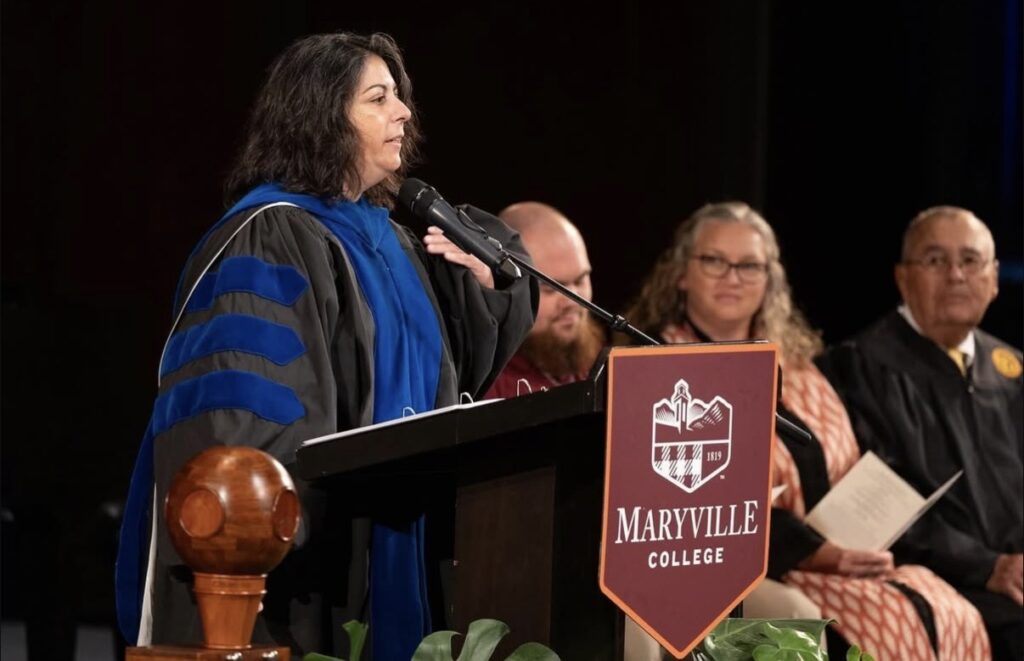
A colleague once suggested to Dr. Maria Siopsis, faculty chair and professor of mathematics at Maryville College, that she could grade homework while watching television in the evenings. It seemed like helpful advice—a way to squeeze productivity into downtime. But for Siopsis, a faculty member with two young children who hadn’t seen their parents all day, the suggestion revealed a chasm between her reality and her colleague’s assumptions. Evenings in front of the TV simply didn’t exist in her world. Even with a partner who shared parenting equally, that wasn’t her life.
The moment encapsulates something larger than a single misunderstanding. It points to the invisible architecture that still shapes who advances in academia—and at what cost. At Maryville College today, women hold department chairs, dean positions and seats in the provost’s office. The landscape of power has fundamentally shifted from a generation ago. But visibility isn’t the same as equality, and representation doesn’t automatically translate to equity.
A more complex picture emerges: one where barriers have evolved rather than disappeared, taking forms that are harder to name and even harder to dismantle.
When Siopsis arrived at Maryville College in the Fall of 2001, several women already occupied division chair roles and faculty leadership positions. These pioneers had clearly worked hard to break through barriers and create pathways for those who followed. They formed a supportive network, but Siopsis could see they had made calculated choices, both in daily behaviors and long-term career decisions, to be taken seriously in ways their male peers never had to consider.
Yet the professional culture still carried assumptions shaped by generational norms. Some faculty came from a traditionalist era popularized on TV shows of the day, like “Leave It to Beaver,” when men weren’t expected to contribute much domestically because women were handling things at home. This sometimes meant that women’s ability to do the job — or their commitment to it — could be questioned, though usually without malicious intent. Colleagues genuinely wanted to be supportive, Siopsis emphasizes, but their lived experiences diverged dramatically.
What emerged wasn’t a traditional glass ceiling but something more corrosive: an internal pressure to perform at the highest level constantly, because any mistake might confirm doubts about whether she truly belonged.
“Today, we’d call that imposter syndrome,” Siopsis said. “We now recognize that it’s not just something you have, but something others can unintentionally make you feel.”
This understanding shapes how Siopsis now works with students. “It’s important to me that every student knows they belong here and that they can succeed, no matter what background or experience they bring with them,” she explains. The lesson cuts both ways: belonging isn’t just about self-confidence but about institutions creating conditions where everyone can genuinely believe they have a place.
The barriers formed by being a woman become starkest around family leave policies. Shortly after Siopsis secured a tenure-track position following a year as an adjunct, she became pregnant with her second child. She planned to take the 14 weeks of family leave the college offered, but the timing created complications. Due in mid-July, she intended to take the fall semester as leave. Since a gap existed between her due date and the semester’s start, leadership questioned when the leave clock should officially begin.
In that uncomfortable conversation with the dean, what Siopsis describes as her “cluelessness” became an unexpected advantage. Not fully versed in professional negotiation protocols, she pointed out that summer weeks were technically outside of her contracted working time and therefore wouldn’t be counted toward her leave.
Ultimately, she secured the entire semester as the leave she desired, but even with it granted, making it work when a household is dependent on an expectant mother’s income often proves complex and disheartening: If a family cannot afford to lose that income for months, then the policy exists only on paper.
Dr. Liz Perry-Sizemore, vice president and dean of the college, attended a women’s college and worked in both female-dominated and male-dominated academic environments. These experiences sharpened her observations about gender dynamics in professional settings. She makes a point to develop strong professional networks, invest in meaningful mentorships and advocate for herself.
She remembers how, years earlier, male colleagues would ask her to remind them of when certain meetings were supposed to take place, as if she, as a woman, somehow served as an unofficial “secretary” for those who planned to meet. However, she acknowledges, most of those colleagues likely never really connected the dots or saw that such requests were demeaning and demoralizing.
When women continually take on and internalize these kinds of requests, they become stretched too thin. This diminishes job satisfaction and hinders their capacity to pursue and accomplish broader career objectives.
“While it can be hard sometimes to find the most appropriate and productive way to speak up about these things, it’s necessary that we do,” Perry-Sizemore said.
This pattern—what researchers call “academic housework”—disproportionately falls to women. Siopsis describes how female faculty often become the default source of emotional support for students, especially when colleagues set stricter boundaries. When students need extra advising help or personal guidance, they gravitate toward women faculty, who then face an impossible choice: sacrifice personal time or sacrifice professional development opportunities.
As a first-generation American and first-generation college graduate from a working-class immigrant home, she entered academia without knowing many unwritten rules of professional settings.
“In some ways, that may have even worked in my favor because I was less aware that I should behave in certain ways, and therefore, maybe I self-censored a little less than others who were more savvy,” Siopsis said.
She also learned by listening to discussions among senior faculty during meetings and forums, and by serving on committees with them.
“As a first-gen American, I think I am a bit of a native learner of unwritten rules, too,” she said. “When you grow up switching between two cultures, you learn a lot about reading a room and figuring out the expectations through observation.”
Noah Bowman, director of academic support who has worked at Maryville College since 2009 and advanced from specialist to director, describes his own journey of adaptation. He’s had to learn how to effectively navigate different types of professional personalities. What helped him advance to leadership, he says, was grit, determination, consistency, strong partnerships with key stakeholders and always remaining student-centered in his approach.
But he has also modified aspects of his personality and professional language to be taken seriously in the college employment setting. His wife, Dr. Alayne Bowman, recently gave him advice he found valuable: Stop trying to be funny at work. He’d learned through difficult experiences that not everyone shares his sense of humor.
“Being too comfortable and making assumptions about people around me have gotten me in trouble from time to time,” he said. He realized he should keep off-hand comments and jokes to himself.
What’s striking is how both women and men describe adjusting their authentic selves to fit professional expectations. Yet women’s accounts carry added weight — the sense that their natural communication styles face greater scrutiny and require more fundamental modification.
When asked what she might observe in rooms where she’s not present — promotion committees, budget meetings, leadership selections — that would explain women’s advancement patterns, Siopsis doesn’t point to overt discrimination in formal meetings. As faculty chair, she’s been in those rooms frequently over the past eighteen months. There are many women in those spaces, and the college has outspoken women leaders she’s grateful for. She wouldn’t say the institution is completely gender or culture-blind, but intentionality exists around representation. Over time, she hopes to see greater cultural diversity in leadership, something she knows MC President Dr. Bryan Coker and others also prioritize.
Siopsis points to social time as the building block for personal bonds that can carry into decision making spaces.
“That’s where we all need to be mindful,” she said. “We have to work at being inclusive and at separating social bonds from professional ones — which is not easy. But being aware of those dynamics is a necessary part of making sure that advancement and opportunities are equitable for everyone.”
Dr. Ben Stubbs, vice president and dean of students, who has been at Maryville College for 14 months in a student affairs leadership role, acknowledges this dynamic from another angle.“Here specifically at Maryville, one of the things that has been important to me is to develop a constructive relationship and reputation among the faculty in particular,” he said. He sometimes finds himself explaining his educational background and experience to earn credibility and trust.
In leadership meetings and decision-making spaces, Stubbs hasn’t necessarily had to work harder to be heard, but he’s been intentional about synthesizing and summarizing others’ contributions.
“I certainly recognize that having the title that I have, and also being a male in spaces that are often either 50-50 or even more populated by women, I have to be mindful about how I might be perceived or how I might come across,” he said. He tries to foster collaborative dialogue and avoid steamrolling opinions or stifling conversation.
The fact that a male leader feels he must be intentional about not dominating mixed-gender spaces suggests progress. Yet it also reveals how default patterns of authority and voice distribution still tilt along gender lines, requiring conscious effort to counteract.
Perry-Sizemore frames her hope for the next generation around a simple but profound wish: “I hope women feel increasingly heard and respected when they share how their observations and experiences affect their ability to thrive and lead.”
The phrasing is telling — not hoping the obstacles will disappear, but hoping that when other women reach those obstacles, their perspectives will be taken seriously.
Siopsis hopes that by the time the next generation of women faculty and administrators reach her career stage, truly equitable family and medical leave policies will exist—policies that don’t make someone’s economic situation the determining factor in whether they can take needed time. And that applies to people of all genders. She also hopes there will be less tone-policing, whether imposed by others or internalized.
“People of different genders, regions, cultures, and economic backgrounds should be able to bring their authentic selves into any professional space and still be heard and taken seriously,” she said.
There’s value in having a shared sense of what professional communication looks like — it provides a common framework for interaction. But she hates the idea that someone might hold back a great idea because they’re afraid their natural way of expressing themselves will lead to being misunderstood or dismissed.
The presence of women in leadership positions proves that advancement is possible. What remains unresolved is whether advancement should require this level of adaptation, performance, and personal cost, and whether the path to power should demand that women either absorb these burdens silently or expend additional energy naming and challenging them while still fulfilling the jobs they were hired to do.
Siopsis notes that she benefited from trailblazers who broke through barriers before her arrival, making her own path somewhat easier. The question facing Maryville College — and higher education generally — is what barriers the current generation of women leaders will dismantle for those who follow.
Will the next generation still negotiate when family leave begins? Will they still feel imposter syndrome not as a personal failing but as something institutional culture creates? Or will they finally walk through doors that don’t require quite so much force to open?
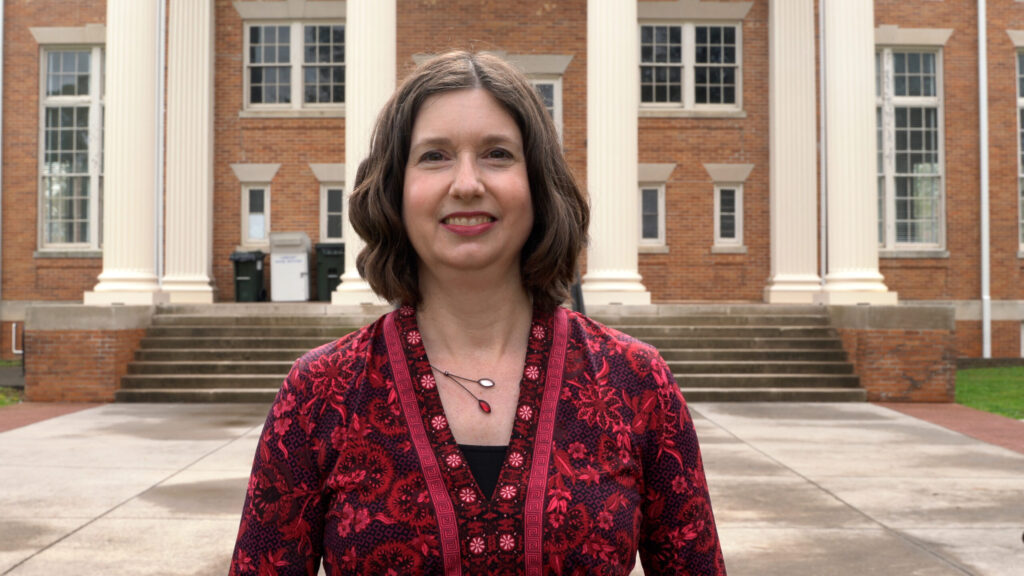
Dr. Liz Perry-Sizemore, vice president and dean of the college, standing in front of Thaw Hall, Photo courtesy of MC Marketing & Communications.