Electric scooters on campus stircontroversy: innovation or invasion?
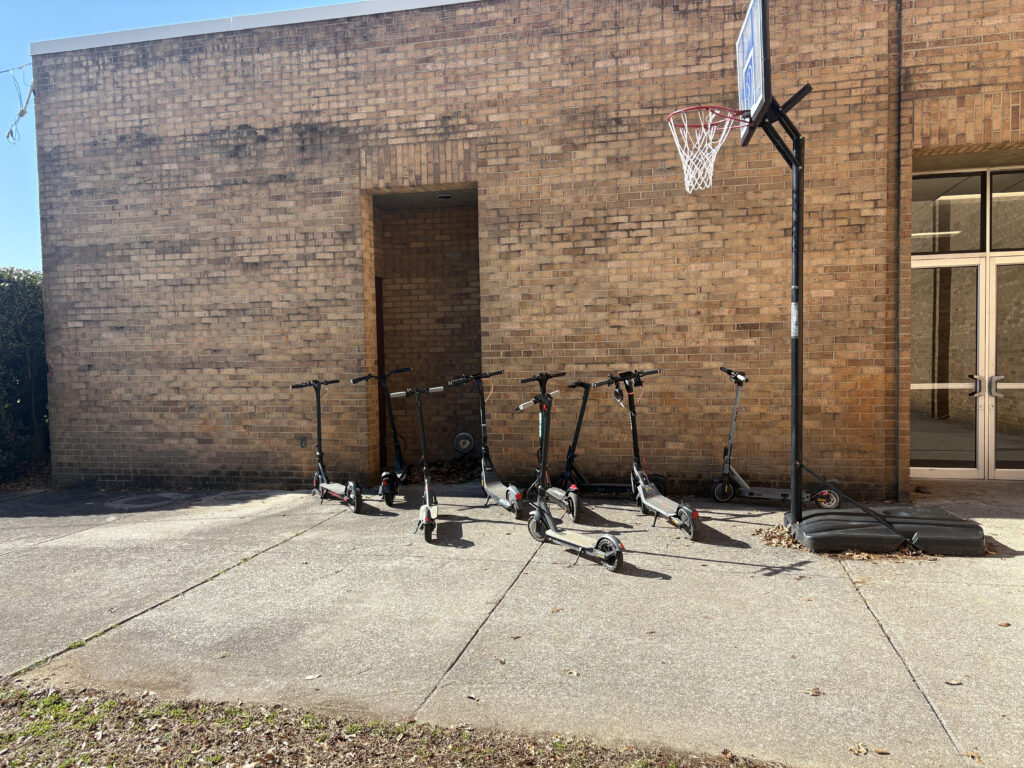
The 2025-26 school year has been defined by a few key factors on the Maryville College campus, one of which is the unrelenting presence of electric scooters. Students use scooters to travel across campus quickly, making those who are walking on the lookout for scooters barreling past them.
Scooters can be found bunched together outside of academic buildings, dorms and the Cooper Athletic Center during class time or practice.
Some students believe the scooters are extremely useful, allowing them to reach their location effectively and efficiently.
“The scooters are fun and help me get around campus quickly,” Jalen McCullough (‘28), an avid scooter user, said.
Other students find the electric scooters to be both annoying and useless.
“I hate scooters so much. I can walk a circle around the campus in 10 minutes and you want to ride a scooter to class?” Jada Harris (‘28) asked.
Electric scooters are primarily ridden by student athletes, causing some to question why they’re a necessary part of MC campus culture.
“There’s no reason to have a scooter. It’s not even the non-athletes who are riding them. I would get it if you were tired, but you’re an athlete and you’re choosing to be lazy. You’re choosing this life; I don’t understand,” Harris added.
Scooters also may pose a safety risk to both the students who utilize scooters and those who don’t.
Harris said, “They ride them in the street. [When driving,] I almost hit them because they’re in the middle of the road.”
Alex McCullough (‘19), director of community standards & associate director of residence life, said that the Residence Life Office, Office of Community Standards and Office of Safety and Security met to discuss the issue of electric scooters.
McCullough said, “Currently, there are no policies that mention scooters specifically. However, existing policies related to ADA compliance and egress may apply if scooters block doorways, walkways, or other accessible routes. Campus spaces must remain accessible and navigable, so Facilities, Residence Life and Safety and Security work together to help ensure that happens. If scooters are blocking walkways or doorways, they will likely be moved or confiscated, just as any item obstructing access would be.”
“We also revisited the 2016 policy that banned hoverboards from campus due to the fire risks associated with faulty lithium-ion batteries,” McCullough said. “We have begun conversations about developing a policy related to scooters and similar devices, but any new policy would not go into effect until the Fall 2026 semester.”
Jalen McCullough said the fad began when the scooters became popular with the football players before spreading to student athletes on other teams.
He discussed how to navigate the difficulties of owning a scooter, saying: “You do have to charge them, and you need to be careful of pedestrians. These are pretty simple tasks, though, and it’s worth the ride.”
McCullough said that for safety reasons, “It is important for students to know that scooters may not be left in lobby spaces or other public indoor areas that are not designated bike rack locations. Scooters blocking stairways, doorways, or other pathways may be confiscated by Safety and Security or Residence Life staff.”
Jalen McCullough urges students to give electric scooters a try, saying, “Get one, and you’ll understand.”
A group of electric scooters outside the Cooper Athletic Center. (Photo Courtesy of Jacey Goetzinger).