Maryville College registrar misdelivers emails, miscommunication with students
Over winter break, the Maryville College registrar was responsible for sending out several emails to students regarding their academic standing and their enrollment for the spring 2026 semester.
But due to human error involving mail-merge features, many of those important emails were swapped. One mistaken email, in particular, contained private student information and disclosed names.
The email was sent to 16 students notifying them that their suspension appeal had been denied, according to Vice President and Dean of the College Dr. Liz Perry-Sizemore. The email was intended to be sent to each student individually, but instead, they received an email containing all individual letters, with the list of recipients’ names attached at the bottom
The email students received was intended for a small number of employees at Maryville College who needed to know this information.
According to Jerilyn Swann, associate academic dean and acting registrar at the time, the mistake was caused by the mail-merge feature.
“Mail merge allows you to input information from an Excel table into a form letter and send it,” Swann said. “It’s a multi-step process that includes selecting the letter you want to use from a folder.
“There were two drafts in that folder, one to go to each student individually and another that had the same letter the students got, but also had the list of students it went to listed at the bottom – intended for a small number of employees. The error happened when the file that was intended for the employees was selected for the mail merge that went to the students.”
A staff member quickly noted the error, and the emails were removed from the server just over an hour after they were delivered, according to Perry-Sizemore.
“The sender realized after less than an hour of it being sent that the letter that was attached had all the students’ names listed at the bottom,” Swann said.
According to Swann, emails like these typically come from the Registrar. Until January 20 of this year, Swann was the acting registrar. The letter was signed by the Chair of the Committee on Academic Standing, Dr. Heather McMahon.
“Maryville College’s FERPA (The Family Educational Rights and Privacy Act) compliance officer took steps to ensure the matter does not happen again, properly documented the matter and filed it with the College’s privacy violation files,” Perry-Sizemore said.
“Impacted students were notified as required by the college’s FERPA and college privacy policy violations procedures. While the college took this FERPA compliance concern seriously and responded appropriately, the matter did not rise to a level that required reporting to the Department of Education.”
According to Swann, affected students received three follow-up emails: one from Perry-Sizemore, who sent an initial letter informing students of the breach, explaining what had happened and informing the students that they would receive additional information from the acting registrar and FERPA compliance officer.
Perry-Sizemore also sent a second letter the same day, repeating what was in her first letter and explaining further that the information they inadvertently received should not be shared with others and asked them to delete the email they had received in error.
Students then received a third letter on Jan. 19, this time from Swann, who was the FERPA compliance officer for Maryville College at that time.
“The email from me again apologized for the error and explained that although names, email addresses and ID numbers had been shared with a small number of students, no other personally identifiable information was shared, corrective action had been taken and I included information for how to file a complaint with the U. S. Department of Education if they chose to do so,” Swann said.
“Fortunately, in this case, no student information was shared that would allow someone to commit fraud by stealing an identity (no Social Security numbers, no physical addresses, no birth dates, or the like). This is why the college does not have to self-report this incident to the U.S. Department of Education.
“If this had been a breach of personally identifiable information that would have posed a risk of fraud against one or more students, then we would have been required to self-report. That’s the law. Thankfully, while we do deeply regret having accidentally shared some students’ suspension statuses with others, this incident does not represent a dangerous breach of information. Even so, we strive for continuous improvement,” Swann said.
Despite striving for improvement, that was not the only email mistakenly sent that month.
On Dec. 16, some Maryville College first-year students received an email falsely stating that, due to their academic performance during the fall 2025 semester, they were suspended from the college, effective immediately.
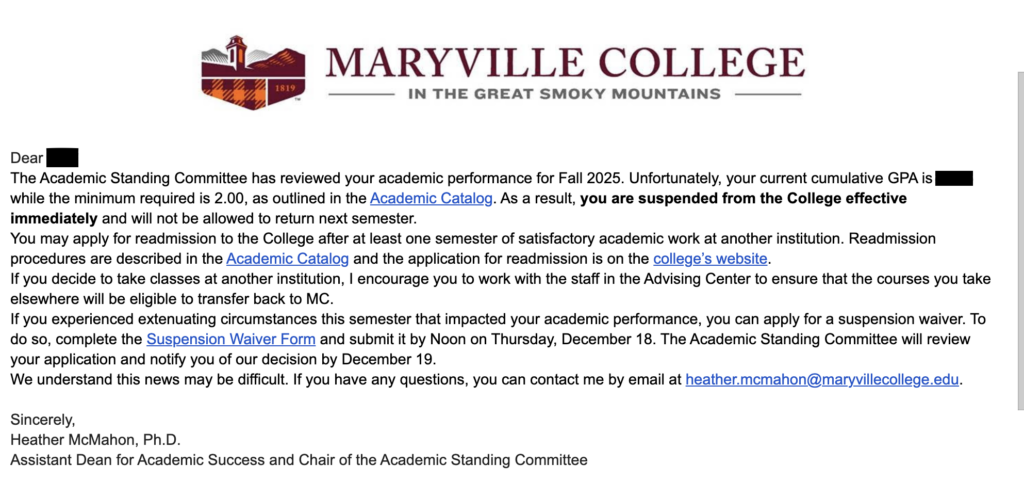
The email read, “The Academic Standing Committee has reviewed your academic performance for Fall 2025. As a result, you are suspended from the College effective immediately and will not be allowed to return next semester. You may apply for readmission to Maryville College after at least one semester of satisfactory academic work at another institution. Readmission procedures are described in the Academic Catalog and the application for readmission is on the college’s website.
“If you experienced extenuating circumstances this semester that impacted your academic performance, you can apply for a suspension waiver. The Academic Standing Committee will review your application and notify you of our decision by December 19. We understand this news may be difficult.”
Due to the email coming from an official Maryville College email address and being signed by McMahon, students believed they had actually been suspended after just one semester.
“I thought it was real at first,” one student who received the email, and wishes to remain anonymous, said. “I called my family and was like, ‘Hey, I’m getting suspended. I’m not 100% sure why, though.’ I sobbed for so long.”
So how did this mistake happen? According to Swann, the wrong letter was selected for the mail merge process. Instead of receiving the standard letter informing first years that they were being put on academic probation, they were sent the letter that notifies students of their suspension.
“While not all students on probation are first-year students, there are two different form letters for probation, one for first-years and one for upperclassmen,” Swann said. “The only group that mistakenly got the wrong letter at first were the first-year students.”
The registrar’s office would not disclose just how many first-year students were put on academic probation and therefore received the email, but according to Swann, just over 10% of the freshman class is on academic probation.
“Within an hour, I got emails from students asking why they’d been suspended when their GPAs were above the suspension threshold,” McMahon said. “Those students’ messages alerted us that we needed to act quickly, which Dr. Swann did.”
The initial incorrect email was sent to students at 11:56 a.m. The apology and correction email was sent just under an hour later, at 12:49 p.m., the same day.
The apology letter read: “Hello, I sent you the wrong notice. Please accept my sincerest apologies for my error. The correct notice will be sent shortly,” with the subject line “WRONG NOTICE SENT: YOU ARE NOT SUSPENDED.”
Despite the swift apology, many students feel that it was an inadequate apology for the stress and anxiety the email caused.
“It didn’t really feel like an apology,” the anonymous student said. “Just something quick. By nature, I don’t ever get mad, but when they emailed me back saying they made a mistake, that genuinely just made me so mad cause, like, emotional whiplash. How does someone just tell someone on accident they’re suspended?”
According to Swann, the small number of students who emailed the registrar about the mistake were very gracious, expressing their relief and understanding that this was simply an accident.
“I imagine there were students who didn’t email us who were upset, which is completely understandable,” Swann said. “I hope their anxiety was short-lived, and I appreciate their forbearance as we all strive for continuous improvement.”
The false suspension email sent out to first-year students on academic probation. (Photo courtesy of anonymous recipient.)
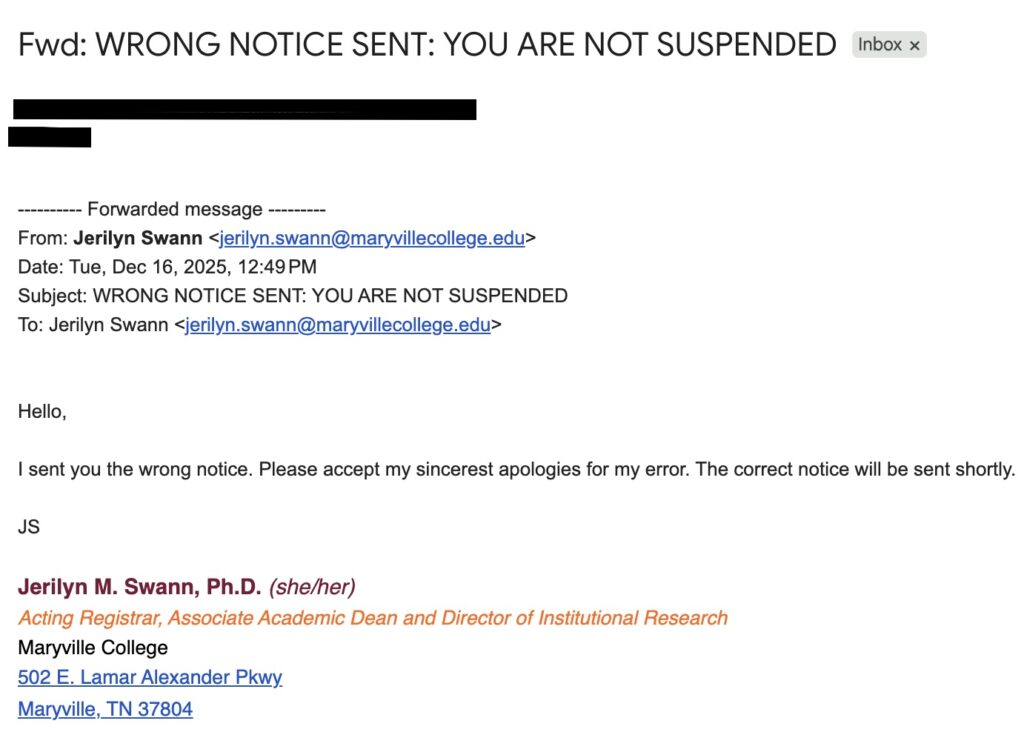
The apology letter informing students that the wrong notice had been sent.
Photo courtesy of anonymous recipient.