Delta Kappa Epsilon and the history of Greek life at MC
Going to college is a complex time for many – entering a new chapter can be exciting and frightening. Some students find it difficult to adjust to this change.
Finding on-campus communities to join can make the transition easier by providing support and companionship along the way. Some people find company within their major, some on their sports teams or clubs… and some go Greek.
MC does not allow Greek life, so students cannot find fraternity or sorority houses on campus, and there are currently no Greek organizations directly associated with the College. However, there has recently been discussion of bringing in Greek life at MC to boost enrollment.
During the Fall 2025 semester, the Campus Life Exploratory Committee (CLEC), led by Vice President and Dean of Students Ben Stubbs and composed of students, faculty and staff, mentioned Greek life as a way to enhance campus experience.
“The Campus Life Exploratory Committee will not determine whether the College will recognize fraternities and sororities in the future,” Stubbs said. “If, in the course of our work this year, the committee feels that the College should consider recognizing these organizations, we would then gather feedback from all campus stakeholders to inform any potential recommendations.”
Stubbs said that MC last reviewed the policy banning Greek life on campus in 2001. Stubbs commented on how Greek life has evolved since then, noting that many colleges now welcome culture-based and co-ed fraternal organizations, and noted that national organizations now house more inclusive membership policies.
“Communities change over the years, and I think that we best serve our students when we review our practices and policies from time to time,” said Stubbs. “Even if we don’t ultimately make a change, the review process can help us articulate our values and identify new ways to foster a connected, fun campus experience that helps students achieve their goals.”
Listening sessions focusing on the topic of introducing fraternities and sororities took place on March 12, where students and faculty provided opinions on the matter. Stubbs said that, given the time in the semester, many students were not able to attend and engage in the conversation, so conversations have been deferred to the 2026-27 fall semester.
“We want students to be able to focus on end-of-year tasks and celebrations,” said Stubbs. “We, the exploratory committee, really want to feel like we have had the opportunity to engage in a deliberate, careful, thoughtful process that everybody had the chance to weigh in on.”
During the fall semester, likely September or October, the committee will revisit the conversation. Stubbs said it will depend on how students respond to the survey. If no one is interested, then there will be no further discussion or meetings. However, if a significant number of students, even fewer than half, are interested in Greek life, then there will be a continued discussion in the fall.
“We are all engaging in this process to hear from students, to hear from faculty and staff, to weigh the pros and cons, and then make an informed decision from there,” said Stubbs. “So, I really want to encourage students to take the survey, to speak their minds, and to attend sessions offered in the fall, if they are offered.”
Currently, there is only one Greek organization at MC: Delta Kappa Epsilon.
The first chapter of DKE was established at Yale University in 1844; it is one of the oldest fraternities in the United States. Men of this organization have gone on to have notable careers, including six presidents of the United States: Presidents Rutherford B. Hayes, Theodore Roosevelt, Franklin D. Roosevelt, Gerald Ford, George H.W. Bush and George W. Bush.
According to the Maryville College Archives, in the spring semester of 2001, the Student Government Association opposed the establishment of Greek life on campus following an application for Delta Kappa Epsilon to be approved as a club.
SGA held several public forums, where many students raised their voices. According to MC Alumni Christine Collins, who wrote for The Highland Echo in 2001, approximately 50 people attended the first forum at the Center for Campus Ministry on Feb. 13 of that year. By the second forum, just two days later, held on Feb. 15, approximately 85 people were in attendance.
According to MC Alumni Daniel Paxman, from The Echo in 2001, SGA voted to decline DKE’s request for recognition. Given the overwhelming negative responses to the idea and SGA’s decision, MC’s handbook was amended to include a clause prohibiting school-chartered Greek organizations.
The code of conduct in the handbook includes the clause “Social fraternities and sororities.” The clause refers to the forums held in 2001 and to the decision not to recognize DKE. It further states that on Oct. 18, 2002, the MC Board of Directors established a policy prohibiting any students from joining or participating in fraternities and sororities or other organizations with selective membership.
The clause begins by stating, “Maryville College believes that an inclusive, open community is fundamental to its mission as a residential institution of higher learning committed to the liberal arts tradition. It is for this reason that Maryville College has maintained a long history and tradition of not including fraternities and sororities in its campus life.”
Following the decision, the “Dekes” persisted. In the summer of 2001, after many city hall meetings, the City of Maryville approved the establishment of an official chapter of Delta Kappa Epsilon. Ever since, the organization has been able to practice freely, though they are not associated with MC.
During spring 2025, members of DKE returned to SGA seeking recognition from the College.
“They were trying to get support, but they didn’t,” said SGA Public Relations Representative Savannah Latham (‘28).
Members of DKE met with the SGA to discuss their organization in hopes of receiving support toward recognition. However, SGA, even 24 years later, remained opposed to supporting DKE’s recognition.
“They wanted to try new people, there are new people in SGA and new people in DKE,” said Latham, “I guess they wanted to see if the opinion changed.”
Rayna Welsch (‘28), SGA sophomore Vice President, believes Greek life does not belong at MC.
“I know there’s talk about ‘giving the people what they want,’ but often that just means giving them a way to party,” said Welsch. “I don’t see Maryville as a party school; I see it as a beautiful campus where students get a meaningful introduction to real life.”
Welsch said that DKE has been offered solutions from SGA, such as becoming an official club. However, they were not interested in that. According to Weslch, members of DKE primarily want to overturn the rule prohibiting Greek life on campus and be recognized as a fraternity in association with MC.
“There was a chance to build something inclusive, but they chose a different path,” said Welsch.
Despite the existence of an official DKE charter through the City of Maryville, public sentiment on campus is not exactly welcoming toward the organization.
“Many students, myself included, chose MC because there is no Greek life and because it is a small campus,” said McKenna Marr (‘28). “Many students will want nothing to do with any future sororities and fraternities.”
Marr said that bringing in new things to boost enrollment and student involvement is a positive thing – as long as it isn’t Greek life.
Besides, Marr also noted, MC can only house approximately 1,200 students. If the College were to lift the ban on Greek life to boost enrollment, increased admission numbers could very well lead to a housing shortage.
However, Stubbs said there are many small liberal arts colleges with active Greek life programs that MC could learn from, if administrators were to lift the ban.
The addition of Greek life also presents concerns about how party culture could continue or worsen campus. Students have reported walking around the College Woods after a buzzing night at the pavilion and seeing leftover trash littering the woods.
“On multiple occasions, I have gone on a walk through the Maryville College Woods and have come across the loud noises and bustling of a pavilion party,” said Marr, “and each time it drastically changed the atmosphere of the woods.”
If only one Greek organization can cause such negative effects to the campus at its parties, students question how MC’s beautiful and historical campus would be affected if more organizations were brought in.
Marr suggested that if DKE became an MC-affiliated club, as SGA has indicated to them, it could reflect positively on the campus community.
“I think if the Dekes wanted to compromise with MC and become an MC-affiliated club, they could actually do the good they claim they do for the college and surrounding community,” said Marr, “all while working with members and [residents] of the college to keep it a safe, comfortable and enjoyable place for everyone.”
Despite a lack of support from SGA and the College, DKE is still active, and continues to thrive.
The President of Maryville’s DKE, as of fall 2025, is E.J. Smith (‘27). Smith declined to comment on DKE’s current standings and the possibilities of Greek association with MC.
However, former president of DKE Braydon Lamb (‘23) shared what it was like to be a part of DKE and what their organization represented to him.
Lamb emphasized that the primary function of DKE, and many Greek organizations, is to provide a community that keeps the members in school. He stated that DKE is much more than a mere party group: it is intended to provide a supporting foundation for its members.
“A big part of the fraternity is keeping kids in college that may not have made it through without the brotherhood,” said Lamb.
Lamb said that to remain in the fraternity, members must attend study hall hours. He said that they make rules and requirements of that nature to keep members from falling behind or even dropping out.
DKE not only benefits its members but also the surrounding community, he added. Lamb said they volunteer by working with churches, schools and nonprofits.
Lamb also said that DKE does a lot of volunteer work to raise awareness of men’s mental health, which is a primary focus of their organization.
According to Lamb, one year, the members of DKE helped hide Easter eggs at a local church for their Easter egg hunt. Along with that, he said that they volunteered with the local Boys and Girls Club and with alumni.
According to the Maryville DKE Instagram, DKE members work closely with Walland Elementary School in Blount County. In December 2024, members of DKE donated toys to the school’s toy drive as the holiday season approached. In August 2025, members of DKE donated school supplies as the new academic year began.
One day during Lamb’s presidency, a family in Maryville had a tree fall in their yard. The members of DKE were there to help.
“They couldn’t get it up themselves, so I sent the boys over there,” said Lamb. “The boys and I went down there, and we cut up the tree.”
Members also cleaned up the debris and cut limbs out of the family’s yard, Lamb added.
Although the local chapter of DKE is not recognized by or associated with MC, Lamb said they have also tried to give back to the campus community. He noted that many of the College’s unofficial organizations, known as secret societies, the members of which he claims many DKE members befriended, would party and leave litter all over the campus. He said that members of DKE would pick up the litter that was left behind.
“I preached about respecting the campus and not doing anything that could ever hurt the campus image,” said Lamb.
Lamb said that, as president, he made sure that they were giving back to the community and lifting each other, however they could.
“It’s really just to be able to help the community and help each other,” said Lamb. “The role of the president is to make sure that the message flows and is brought alive.”
Lamb expressed his opinions and excitement surrounding the recent discussions of potentially bringing Greek life to MC’s campus.
“I think we would have the best of both worlds,” said Lamb. “If you [bring] Greek life into the community, there will be more outlets for people.”
Lamb said that combining small-campus life and Greek life would greatly benefit the College’s community. He noted that more Greek organizations would provide more communities for students to be a part of, giving new possibilities while maintaining the closeness of the small campus community.
“I just think it is a great way for young men to stay engaged in college,” said Lamb. “Guys are not the best at being like ‘Hey, let’s all go get together and make each other feel welcome.’ There are a lot of kids who fall out of college and do not continue because they cannot find a group of people they want to get involved with.”
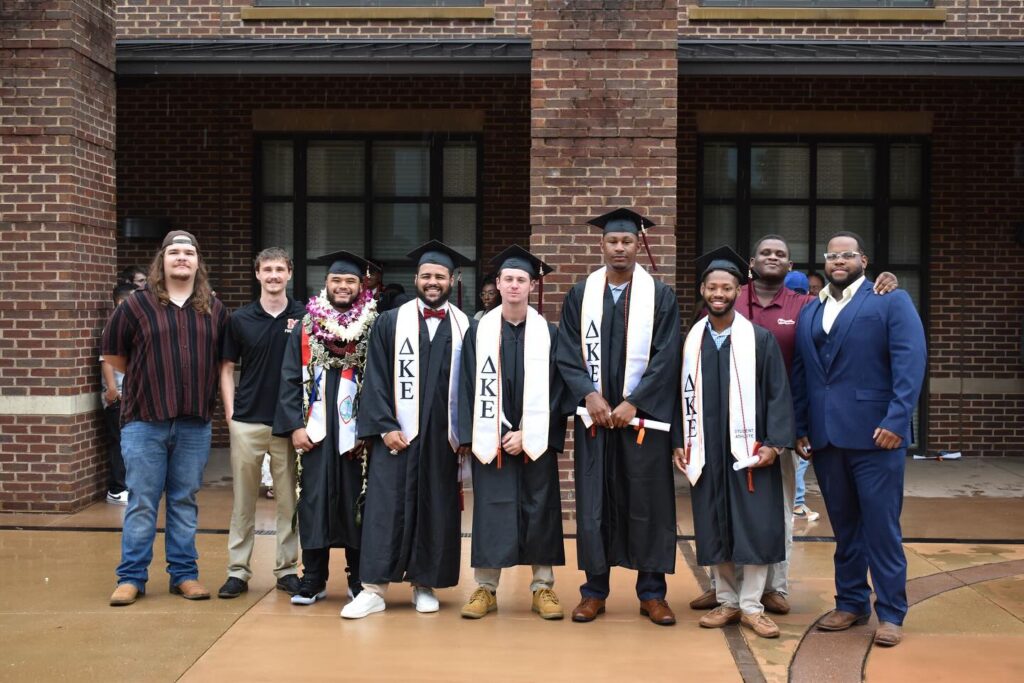
Members of Maryville’s Delta Kappa Epsilon at graduation in May 2025. The graduates wear stoles representing their membership in DKE. (Photo courtesy of @DKEMARYVILLE on Instagram.)
Sounds like Stubbs doesn’t know the history of this because it was also revisited in 2009 when the DKEs wanted to become an official organization and rejected then too.