A behind-the-scenes glimpse into the off-campus lives of some MC faculty

While Maryville College faculty hold rich and inspiring roles within the classroom, the roles they hold outside of the classroom are often fascinating extensions of the very same passions driving their teaching.
Dr. David Unger, associate professor of biology at Maryville College, calls himself “an obsessive diver” – with eight different diving certifications, Unger finds both community and a personal sense of “zen” through diving.
Unger describes underwater as “a world I’m not supposed to be allowed to visit, but [that] I get to, through diving.”
Unger builds community, working with the Blount County Police Force and Blount County Rescue Squad as a Public Safety Diver, while also providing Swiftwater rescue services. Through these organizations, he works to recover objects which have been lost underwater, including vehicles, evidence, and smaller items such as wedding rings. In some cases, Unger has worked to help recover families’ loved ones after disasters, including Hurricane Helene.
Besides diving to assist the community alongside the police force and rescue squad, Unger completes personal recreational dives.
Unger said: “I tend to have a mind that’s going one hundred directions at once at the same time… [when diving] I have three things to think about: how deep am I? How much air do I have left? And where’s my dive buddy?”
The remainder of his focus is spent on the sound of the ocean, and his breathing, which Unger calls “[the] ultimate zen experience.”
Unger’s activities both inside and outside the classroom revolve around engaging in the study of life.
He said: “I love bringing recreational experiences back into the classroom. When I get to go off and play, I love to bring it all back with me.”
According to Unger, his engagement in the study of life and sense of play began in childhood.
“It started in my backyard, and if someone wanted to cultivate [a sense of play], I’d say: get outside, and look around you. If you find yourself death scrolling, go out into the college woods. Look for a salamander, look for a leaf, look for a flower. Lay in the leaves! We have such a short time here that I feel like we need to try and get as much out of that time as possible.”
While Unger’s studies and activities are rooted in the study of life, Dr. Nathan Higdon’s studies are focused on improving processes, and increasing access to resources.
As Higdon holds a Master’s and Ph.D. in Business Administration, his interest in increasing efficiency and effectiveness – inside and outside the classroom – is no surprise. However, Higdon also improves processes in his hobbies and activities outside the classroom, including gardening and mechanic work.
Higdon said: “I love to start things from seeds… it’s really cool to put something in the ground and nurture it, and finally see it turn into a plant or a vegetable.”
Gardening is one of Higdon’s routine activities, where he learns patience and thinks of new ideas. His interest in mechanics is rooted in childhood.
“I watch everything… when I was a kid I liked to take things apart and put them back together… I was in dad’s repair shop fixing client’s cars and also our family’s racecar,” said Higdon. As an adult, Higdon does maintenance for his own cars, recently replacing the rear and front suspension of his own vehicle.
Higdon is big into watching and improving processes, which he also practices through his roles in volunteering, consulting, teaching, and in politics. Higdon serves as vice chair of the Tennessee Democratic Party, and travelled over the last year to over half of Tennessee’s 95 counties to meet with voters and constituents. Higdon also serves as treasurer for Knox Pride, which is the second largest food provider in the city of Knoxville, feeding a range of three hundred to five hundred people a day.
As a seventh generation East Tennessean, Higdon said, “That’s why I’m so political [and] so committed to feeding under-resourced people, because at the end of the day, I didn’t forget what I came from… that’s what drew me into social justice work.”
Higdon’s main goal through all his activities, on and off-campus, is to improve the things around him.
“I like to make stuff better,” Higdon said: “[Students] included! We all do better when we all do better.”
For Dr. Di Bei, who serves as an assistant professor of writing communication at Maryville College, writing isn’t merely the craft she teaches in the classroom, but the craft she cultivates outside of the classroom across various genres.
Bei said, “My belief toward writing is starting with something you know… you should write a sentence you can one hundred percent stand behind, [because] it doesn’t do you any good to say something because you heard someone else saying it before.”
Many of Bei’s own personal pieces of writing are written first from a baseline of lived experience – “Chassé,” Bei’s first novel, tells the story of a teenage ballerina who suffers an injury and gives up her career in dance, later rekindling her passion through horse racing. While details such as the injury are fictitious, the basis for the story draws from Bei’s personal experience, as she herself practiced Chinese classical dance, before later transitioning into modern ballet, and served on an equestrian team. While Bei has written works across various different genres, including novels, short stories and screenplays, she has also practiced other art forms, including acting for both film and theatre, as well as dance.
Bei said, “I have a lot of curiosity for things I never tried, sometimes I [have] tried and persisted in that area.”
After winning a screenwriting contest, Bei consequently starred in the succeeding film following her screenplay: The Chinese Tourist. Premiering in Idaho in 2022, Bei’s film was selected for screening by the Chinese American Film Festival, the LA Women in Film Festival, and the Northwest Film Forum’s Local Sightings Film Festival.
Bei said that, for students aspiring to work on creative projects, “Sometimes you need only one close reader who really cares about your vision [and] about every word you write.”
Collaborating with people who care about your vision can make all the difference, as Bei experienced while collaborating with her director during the production of The Chinese Tourist. However, though having creative community is important, ultimately writers and creatives must discern their own voices through their work, over time and practice.
“The older I get, I pay more attention to the sense of responsibility. I want to take responsibility for every word I produce… that [helps] navigate to find what’s the important story to tell,” said Bei.
Creative expression requires a balance of both community, accountability, feedback and discernment of an inner voice – in addition to finding the story you want to tell.
Bei said: “In the end, you don’t really answer to anyone else – you spend the most time with yourself, it’s important for you to be the most honest with yourself.”
Maryville College faculty exhibit curiosity and dedication to improving the world around them, not only in the classroom through lectures and exams, but also in their lives outside the classroom: whether diving underwater, growing tomatoes, running a political campaign, choreographing a dance or writing a screenplay, Maryville College professors including Unger, Higdon and Bei prove that doing good on the largest possible scale can be a varied and wonderful practice.

Dr. Dave Unger, (center) diving with students on a study abroad trip to Bonaire, Municipality of the Netherlands, in 2014. For Unger, combining diving with teaching his students is a match made in heaven. (Photo courtesy of Dave Unger.)
Dr. Di Bei behind the scenes on set for the film, which she wrote and starred in, The Chinese Tourist. (Photo courtesy of Andrea Carrizales.)
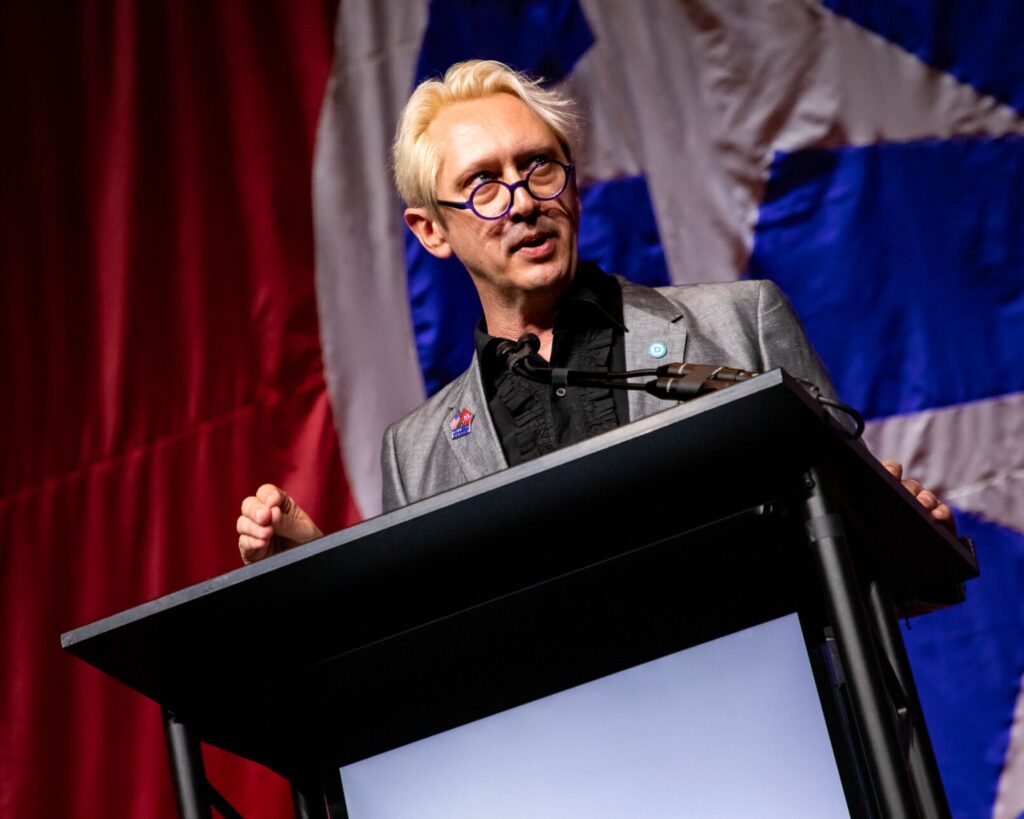
Dr. Nathan Higdon speaking as Vice Chair of the Tennessee Democratic Party. (Photo courtesy of Nathan Higdon.)